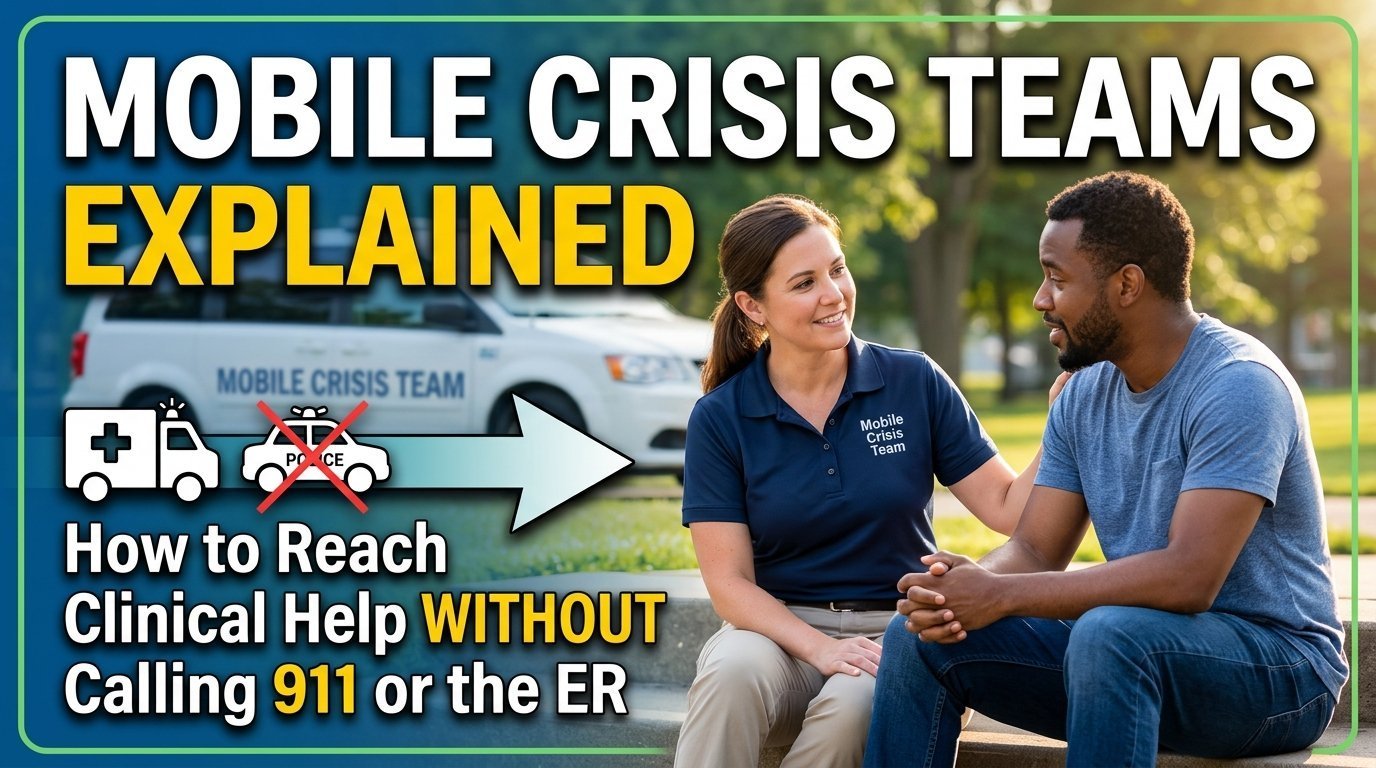
The Phone Number That Could Have Saved a Trip to the ER
Most Americans, when faced with a mental health care crisis at home, have exactly two phone numbers in their head. They call 911, which usually dispatches police and an ambulance, or they drive their loved one to the nearest emergency room. Both responses are blunt instruments. Police arrival can escalate a person already in a paranoid or dissociative state. ER waiting rooms can stretch to twelve hours of fluorescent lights and inadequate psychiatric attention. There is a third option most families never learn about: the mobile crisis team.
Mobile crisis teams are dispatched units of mental health clinicians who travel to the patient instead of forcing the patient to travel to the system. They de-escalate, assess, and connect the person to the next appropriate level of mental health care, often without ever requiring transport to a hospital. They exist in nearly every state in some form, are increasingly accessible through the 988 Suicide and Crisis Lifeline, and yet remain dramatically underused because patients and families do not know how to summon one.
What a Mobile Crisis Team Actually Is
A mobile crisis team typically consists of two to three people: a licensed clinical social worker or counsellor, a peer specialist who has personal lived experience with mental illness or substance use, and sometimes a registered nurse or paramedic. They drive to your home, your workplace, or wherever the crisis is unfolding, in an unmarked vehicle that looks nothing like a police car or ambulance. They wear plain clothes. They knock, introduce themselves, and ask to come in.
Once inside, their first priority is calming the situation. They are trained in trauma-informed de-escalation, suicide assessment, and the soft language of clinical engagement. They sit, listen, and create space rather than demand compliance. For a person in the middle of a panic attack, a manic episode, or a depressive crisis with suicidal ideation, this approach is qualitatively different from the experience of being approached by uniformed officers with badges and weapons.
After de-escalation, the team conducts a structured clinical assessment. They ask about safety, symptoms, recent events, current medications, and existing mental health providers near me. They develop a disposition plan in real time. The plan might include a same-day appointment with the patient’s existing therapist, an admission to a crisis stabilisation unit instead of a hospital, a follow-up visit from the team in twenty-four hours, or, in cases requiring it, a calmer transport to inpatient psychiatric admission.
How to Actually Call One
The fastest national pathway is 988. Since 2022, the Suicide and Crisis Lifeline has been a single three-digit number you can call or text from anywhere in the United States. The counsellor who picks up will assess the situation and, in many states, can directly dispatch a mobile crisis team to your address. Coverage is uneven. Some metro areas have full mobile crisis coverage twenty-four hours a day. Some rural counties still rely on a county sheriff response with no clinical component. Ask explicitly: “Is there a mobile crisis team available for this address right now?”
If 988 cannot dispatch, your county’s behavioural health authority almost certainly operates a separate mobile crisis line. Search for “mobile crisis team” with your county or city name. Most lines are staffed twenty-four hours and route directly to dispatch. You can also call ahead during a non-emergency moment to ask what the local response looks like. Knowing the protocol before you need it saves precious minutes during a crisis.
Some major insurance plans, including networks like UnitedHealthcare therapists, Optum behavioural health, and several Blue Cross Blue Shield variants, provide a member crisis line that connects directly to mobile crisis dispatch. Check the back of your insurance card for a behavioural health phone number. The crisis line is free, confidential, and, importantly, does not generate a claim that goes against your benefits cap.
When Mobile Crisis Is the Right Choice
Mobile crisis teams are designed for situations where the person is in significant distress but not in immediate, active danger to themselves or others. A teenager who is cutting and saying they want to die but is not actively trying to die in the moment. A person experiencing a first psychotic break who is confused and frightened but not violent. An adult with severe panic disorder whose attack has lasted four hours and is not responding to coping skills. A grieving spouse who has stopped eating, sleeping, and speaking and whose family is afraid to leave them alone.
These are situations where a hospital trip is plausible but not certain, where the right outcome depends on a careful clinical assessment that an ER triage nurse cannot provide. Mobile crisis is built for that ambiguity. Clinicians can spend ninety minutes in your living room teasing apart what is happening and recommending the right next step in mental health care. The same conversation in an ER waiting room would happen in three minutes by a nurse with seven other patients.
When to Skip Mobile Crisis and Go Straight to 911 or the ER
Mobile crisis is not the right call for every emergency. If a person has just attempted suicide, swallowed a dangerous quantity of pills or substances, sustained an injury, or is actively trying to harm themselves or others in the moment, call 911 and request emergency medical services. If a person is brandishing a weapon, threatening violence, or behaving in ways that put bystanders at risk, the situation requires law enforcement and EMS together, ideally with a co-responder model where a clinician rides along.
The dividing line is medical urgency and physical safety. Mobile crisis handles the psychological emergency. Emergency medical services handle the medical emergency. When both are present at once, both should be called.
What Happens After the Visit
The disposition planning is where mobile crisis teams demonstrate their real value. Instead of leaving the patient at the door of an ER and disappearing, the team often schedules a follow-up call within twenty-four hours and a follow-up visit within seventy-two hours. They can refer directly into local IOP and PHP programs, into crisis stabilisation units that are gentler alternatives to inpatient admission, and into peer support networks that provide ongoing community.
For families, mobile crisis is also an opportunity to build an emergency plan that did not exist before. The clinician will often spend time helping you write a written safety plan, a list of warning signs, a list of coping skills, a list of trusted contacts, and the steps to take if symptoms recur. This document, sometimes called a Stanley-Brown Safety Plan, has been shown to reduce future crisis events when used consistently.
Cost, Insurance, and Privacy
Mobile crisis services are usually free at the point of contact. They are funded through a mix of state behavioural health dollars, Medicaid, and increasingly federal SAMHSA grant programs. Some teams will bill commercial insurance, including UnitedHealthcare therapists networks and other major carriers, but they will rarely refuse service if a patient is uninsured or unable to pay. The financial barrier that often keeps families from calling is, in this specific case, mostly imaginary.
Privacy is also stronger than most callers expect. Mobile crisis encounters are protected health information under HIPAA. They are not police reports. They do not appear in background checks or housing records. They do not, in most jurisdictions, trigger child protective services involvement unless an actual safety concern about a minor is disclosed. The team will document the visit in a clinical record and share it with whichever provider you authorise, and that is generally the extent of disclosure.
Putting the Number in Your Phone Today
The single most useful thing you can do after reading this article is to add three numbers to your phone, today, before any crisis: 988 for the national lifeline, your county’s behavioural health crisis line, and the behavioural health crisis number on the back of your insurance card. Tell the people who live with you where to find these numbers. Talk through, in advance, what would constitute a moment to call.
Mobile crisis teams cannot help families who do not call them. The single biggest barrier in mental health care is not the system’s capacity. It is the gap between the moment a family realises they need help and the moment they pick up a phone. Closing that gap is the work this article asks you to do. The next crisis in your life may not be your own. Knowing the right number to dial first is a small act of preparation that can change the trajectory of someone you love.
If you or someone you know is in crisis, call or text 988 to reach the Suicide and Crisis Lifeline twenty-four hours a day in the United States. For an immediate medical emergency or active danger, call 911.