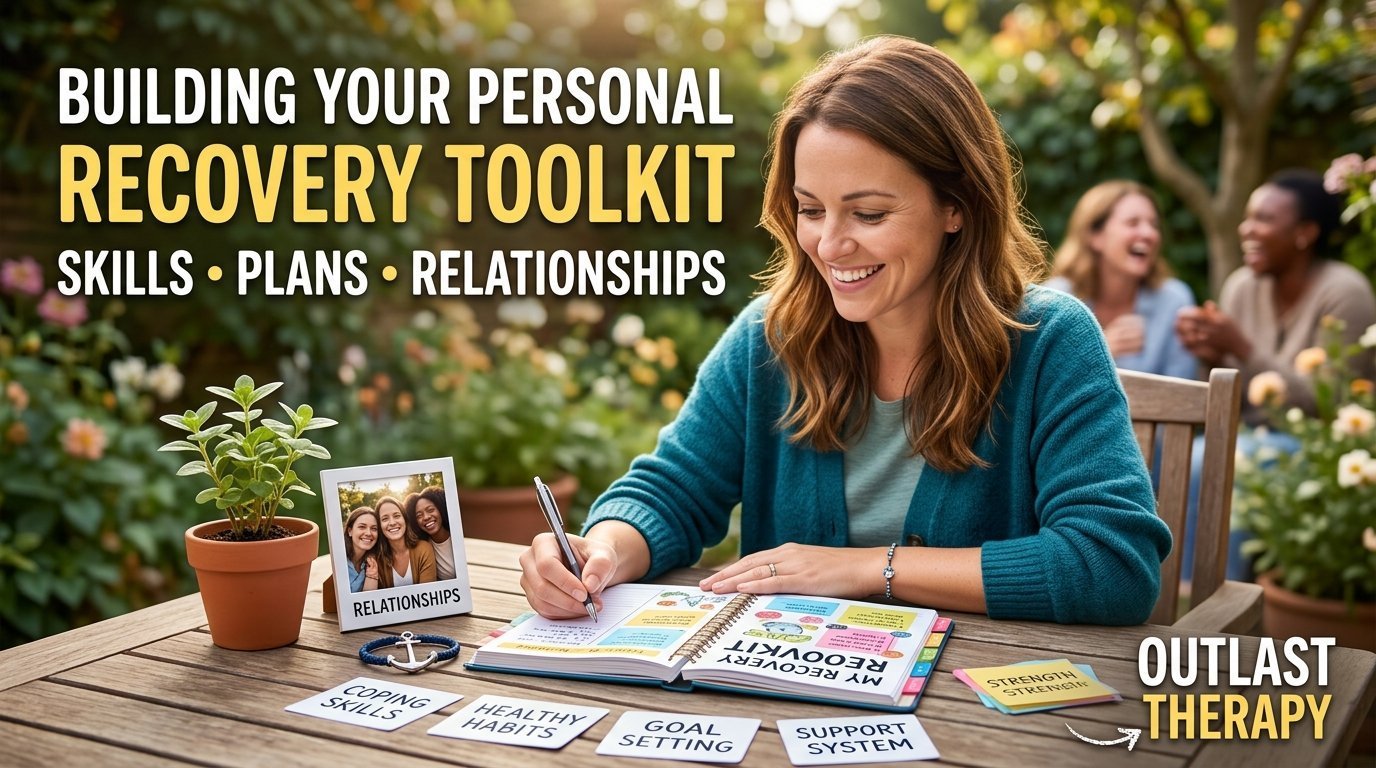
The Question Patients Ask at the End of Therapy
By the time someone has done meaningful mental health care and is approaching the end of a treatment chapter, the question hovering over the last few sessions is rarely “did this work?” It is something more anxious: “what happens when I stop?” The implicit fear is that everything gained during therapy will evaporate the moment the appointments end, leaving the patient back where they started, only with less money and more disappointment.
This fear is understandable but not accurate. The skills, insights, and relational shifts that emerge in good therapy can outlast the therapy itself, sometimes for decades, when patients leave with a deliberate recovery toolkit they continue using. Building that toolkit is itself a clinical project that the last several sessions of treatment ought to be partly devoted to. This article describes what a well-built toolkit contains and how to assemble one before discharge.
Tool One: A Written Personal Recovery Plan
The single most important artefact to leave therapy with is a written document, three to five pages long, that captures the work you did. The document goes by different names. WRAP, the Wellness Recovery Action Plan, is a widely used framework. Stanley-Brown is the standard for safety planning. Some therapists use their own house version. The format matters less than the existence of a written record.
The plan typically includes a description of yourself when you are well, the warning signs that suggest you are slipping, the specific coping strategies that have worked for you in the past, the people who can be called in different kinds of distress, and the action steps for various levels of crisis. The act of writing it embeds the content in a way that mental rehearsal does not. The act of having it on paper means it will be available to you and to people around you years after the therapy ends.
Tool Two: A Skills Practice Routine
Therapeutic skills, like any other learned skill, atrophy without practice. The breathing exercise, the cognitive reframing technique, the dialectical behaviour therapy distress tolerance protocol, the mindfulness anchor, all decay if not used. Build a daily or weekly cadence for practising the skills you found most useful, even when you do not need them. The practice when you do not need them is what makes them available when you do.
The cadence does not have to be elaborate. Five minutes a day of mindfulness practice, supported by an app or a recording from your therapist, builds the skill. A weekly journal entry that revisits a recent challenge through a cognitive reframing lens keeps that frame active. A monthly check-in with the parts of yourself that emerged in Internal Family Systems work, or with the embodied awareness from somatic therapy, maintains the integration.
Tool Three: A Maintenance Provider Relationship
Most patients benefit from maintaining some contact with a therapist or psychiatrist after intensive mental health care ends, even if the contact is far less frequent than the original treatment. A monthly check-in for the first six months after discharge, then quarterly, then annually, keeps a relationship alive that can be intensified if symptoms return. Without it, the next time symptoms return you are starting from scratch, with all the friction of finding a new mental health providers near me and rebuilding rapport.
The maintenance relationship is also useful when the change you achieved in therapy bumps against new life events. A new job, a new relationship, a loss, a major decision. Having someone you already trust to think with for an hour can prevent a small wobble from becoming a full slip.
Tool Four: A Sleep, Movement, and Nutrition Foundation
The biological foundations of mental health are unglamorous but irreducible. Sleep, exercise, and nutrition affect mood, anxiety, and cognitive function more than most therapy modalities want to admit. A recovery toolkit that does not include practical commitments to these three is missing a load-bearing wall.
The commitments do not have to be heroic. Seven to eight hours of sleep on a regular schedule, with a consistent wake time. Moderate physical activity at least three days a week, whatever form you can sustain. A relationship with food that is reasonably consistent, varied, and not punishing. None of these alone treat depression or anxiety, but together they provide the substrate on which therapy gains compound rather than erode.
Tool Five: A Community of Supportive Relationships
Long-term mental health is built on relationships, not techniques. The most resilient former patients are not the ones who learned the most coping skills. They are the ones who left therapy with at least three people in their lives they can call when something is hard. Sometimes those three people emerged from group therapy or peer support meetings. Sometimes they are family members whose role was reframed by the therapy. Sometimes they are friends made decades earlier whose value was rediscovered through the work.
If you do not have those three people, your toolkit is incomplete. The last weeks of therapy are an excellent time to identify the gap and begin filling it deliberately. Peer support meetings, faith communities, hobby groups, alumni networks of treatment programs, and online communities for specific conditions can all be legitimate sources of supportive relationship. Quantity is not the goal. Three reliable contacts beats thirty acquaintances.
Tool Six: A Plan for the Hard Days
Even with every tool above, hard days will happen. Recovery is not a steady upward curve. It is a long upward slope with frequent local dips. The toolkit needs to include explicit plans for the dips: a list of coping strategies tiered from low-intensity to high-intensity, contacts to reach in different scenarios, and a clear threshold at which you would re-engage your therapist or step back into treatment.
The threshold is the important part. Many former patients tolerate too much suffering after therapy ends, treating the return to treatment as a failure. It is not a failure. It is a use of a tool that was always meant to be used as needed. Setting your threshold during therapy, with your therapist, and writing it into your recovery plan removes the ambiguity. When the criteria are met, you make the call.
Tool Seven: Periodic Reflection and Adjustment
Schedule, in advance, a few moments each year to review your toolkit and adjust. New phases of life require new tools. Coping strategies that worked in your twenties may not work in your forties. Relationships that supported you a decade ago may have shifted. Once a year, perhaps on a meaningful anniversary like the date you started therapy or the date you graduated treatment, sit with your written plan and ask whether anything needs updating.
This kind of review is itself a mental health care practice. The therapist’s role of holding the work and revisiting it regularly is one you can take over for yourself once treatment ends. The skills you learned to apply to specific symptoms can be applied to the broader project of staying well over a lifetime.
The Toolkit Is the Real Outcome
The popular narrative around therapy treats outcome as a single binary: cured or not cured. The reality is closer to the toolkit framing. Therapy gives you tools. The tools work as long as you use them. The duration of effect is open-ended. People who maintain their toolkit, even imperfectly, often report functioning years later that exceeds what they hoped for at the start of treatment. People who stop using everything tend to slide.
Building the toolkit before you leave treatment, while your therapist can help you assemble it, is a vastly better strategy than reconstructing it from memory after a relapse. The last several sessions of any meaningful course of mental health care ought to be devoted at least partly to this work. If your therapist has not raised the topic, raise it yourself. The toolkit you build with them is the version of the work you carry forward into the rest of your life.
This article is for educational purposes only and does not constitute personalised medical advice. If you or someone you know is in crisis, call or text 988 in the United States.