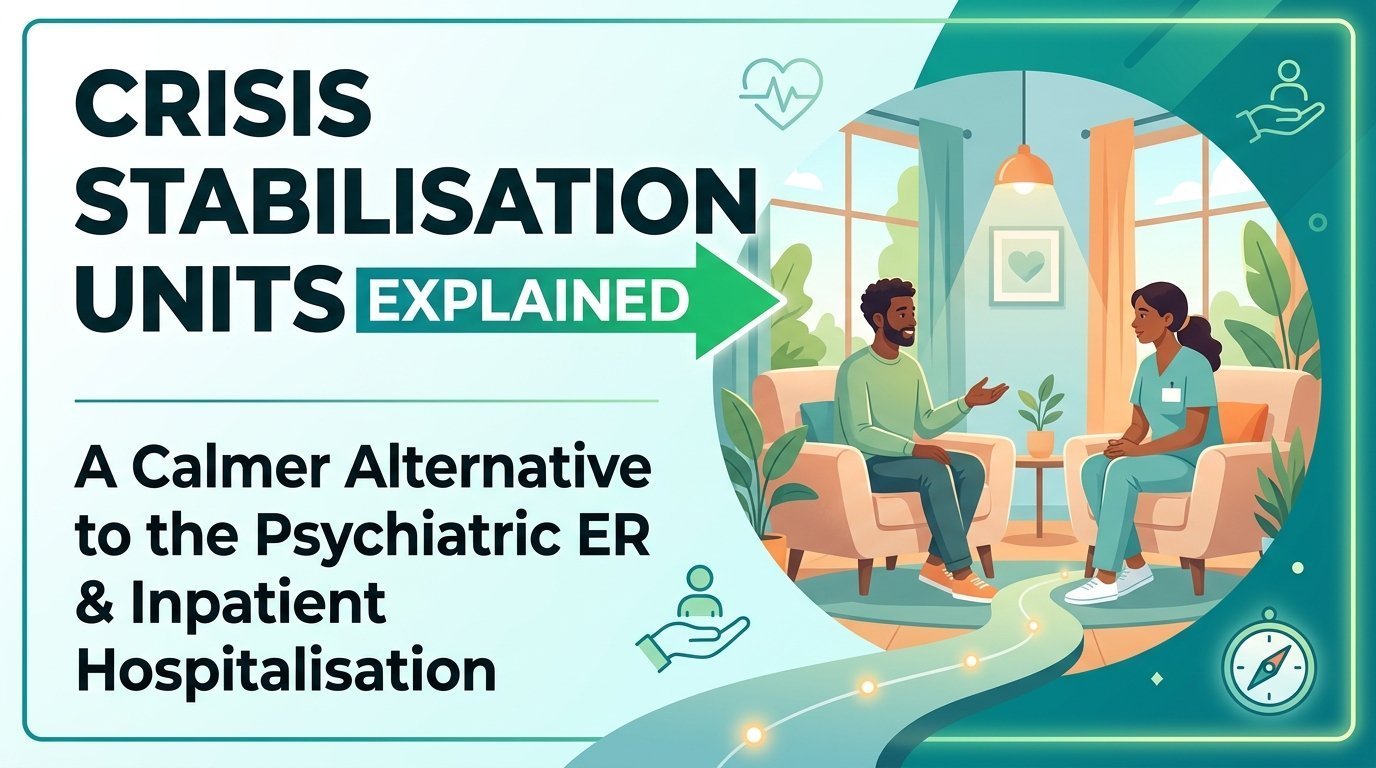
A Calmer Door Into the Crisis System
For decades, the only doors into the mental health care crisis system in the United States were the psychiatric emergency room and the inpatient hospital. Both work, in the sense that they can keep people alive and stabilise the most acute episodes. Both also have well-documented downsides: long ER waits, the trauma of locked units, the financial cost, and the cultural reluctance many families feel about either option. A third door has been opening over the past several years across many regions: the crisis stabilisation unit.
This guide explains what crisis stabilisation units are, how they differ from emergency rooms and inpatient psychiatric hospitalisation, who they serve, and how patients and families access them. The category is one of the most useful expansions in American crisis care in years and remains underused because most patients have never heard of it.
What a Crisis Stabilisation Unit Is
A crisis stabilisation unit, often abbreviated CSU, is a small clinical facility designed for patients in acute mental health crisis who do not need full inpatient hospitalisation but cannot safely manage at home. Units typically have ten to twenty beds, with stays ranging from twenty-three hours to several days. The environment is calmer than a hospital, with fewer locked doors, more flexible room arrangements, and an explicit emphasis on de-escalation rather than restraint.
The clinical staff includes psychiatrists or psychiatric nurse practitioners, nurses, social workers, and increasingly peer specialists who have personal lived experience with mental illness or recovery. The treatment model emphasises rapid assessment, immediate de-escalation, medication adjustment when needed, brief therapeutic engagement, and connection to outpatient mental health care before discharge. The goal is stabilisation in days, not the longer-term stabilisation that inpatient hospitalisation provides.
How CSUs Differ From the Psychiatric ER
The psychiatric ER is part of a general medical emergency department, with all the complications that environment produces. Wait times can be long, often six to twelve hours before a psychiatric assessment. The physical environment is loud, lit, and full of medical activity that can be overwhelming for someone in psychiatric distress. The clinical interaction is brief, with a triage nurse and an emergency physician focused on the immediate decision of whether to admit or discharge.
The CSU is purpose-built for psychiatric crisis. Wait times are typically minimal once the unit accepts an admission. The environment is quieter and more therapeutic. The clinical interaction is longer and more substantive, with time for the patient to be heard, to receive medication adjustment, to participate in brief therapeutic groups, and to develop a discharge plan that connects to ongoing mental health care. The whole experience is less traumatic, particularly for patients with previous bad experiences in emergency departments.
How CSUs Differ From Inpatient Hospitalisation
Inpatient psychiatric hospitalisation is appropriate for patients who pose immediate danger to themselves or others, whose symptoms are severe enough to require twenty-four-hour locked supervision, or whose treatment requires a level of medical management that only a hospital provides. The locked unit is a serious clinical intervention with real benefits but also real costs, including the experience of being locked, the disruption to work and family life, and the cost.
The CSU is appropriate for patients in significant crisis who would benefit from short-term clinical containment but do not need the locked environment. Patients with active suicidal ideation but without specific intent or means. Patients with severe panic disorder whose attacks are not responding to outpatient treatment. Patients in the middle of a mood episode that is escalating but not yet at the level requiring inpatient admission. Patients post-discharge from inpatient who are destabilising and need brief re-stabilisation without full readmission.
Length of Stay and Disposition
CSU stays are short by design. The most common stay is twenty-three hours, sometimes called a twenty-three-hour observation, after which the patient is either discharged with a connected outpatient plan or transferred to an inpatient unit if symptoms have not stabilised. Some units offer longer stays of three to five days for patients who need a few additional days of structure but still do not require inpatient care.
The discharge planning process is one of the strongest features of CSUs. Because the unit specialises in crisis stabilisation rather than long-term treatment, the entire stay is oriented around connecting the patient to ongoing mental health care. Many CSUs have direct relationships with local IOPs, PHPs, community mental health centres, and private practices, allowing for warm handoffs that produce much higher follow-up rates than ER discharges typically achieve.
How to Access a CSU
The fastest pathway is through 988, which can in many regions dispatch a mobile crisis team or directly refer to a local CSU when one is available. Mobile crisis teams often have direct admission privileges to local CSUs, which means the patient can go from a home assessment to a CSU bed without ever entering an emergency room. The smoother handoff is a major reason mobile crisis teams paired with CSUs have produced measurable improvements in crisis care quality where they exist.
Direct walk-in access varies by region. Some CSUs accept self-referrals during business hours, while others require referral through a clinician or crisis service. Family members can call ahead to a CSU and arrange admission for a loved one in many cases. The local behavioural health authority can confirm what your specific region offers. Networks behind UnitedHealthcare therapists, Optum, Aetna, Cigna, and Blue Cross Blue Shield variants increasingly publish CSU access information in their member portals.
Insurance and Cost
Insurance coverage for CSU stays varies. Most plans cover the service under behavioural health benefits, with cost-sharing similar to PHP or inpatient depending on the specific plan and the duration of the stay. Some plans require prior authorisation; many waive it for emergency crisis services. Patients enrolled in Medicaid have particularly favourable coverage in most states, since CSUs are often funded specifically as part of the Medicaid behavioural health benefit.
For uninsured patients, many CSUs are funded by state behavioural health dollars and provide services regardless of ability to pay. The financial barrier to accessing a CSU is generally lower than the barrier to accessing inpatient hospitalisation, which makes the option particularly important for patients who would otherwise delay seeking help due to cost concerns.
Who CSUs Help Most
The patient profiles that benefit most from CSUs are usually patients in significant distress whose situation does not yet meet inpatient criteria but cannot be safely managed at home. Adults in the middle of a depressive crisis with suicidal thoughts but without specific plans. Adults with severe anxiety or panic that is not responding to outpatient treatment. Patients with substance use crises that have not yet reached medical complication. Patients in early psychosis who are frightened and disorganised but not in immediate danger.
The model also serves patients who would benefit from inpatient care in principle but whose situation makes inpatient admission impractical. Single parents who cannot leave children for several days. Workers without sufficient leave for a week-long admission. Patients whose previous inpatient experiences were traumatic and who would rather avoid admission if possible. The CSU offers a level of intervention that fits these constraints while still providing meaningful clinical containment.
An Underused Resource
CSUs remain dramatically underused in many regions, partly because they are newer than ERs and inpatient units, partly because patients and families do not know to ask for them, and partly because some emergency departments default to admitting or discharging without considering CSU referral. Asking explicitly about CSU options when a crisis develops can sometimes produce a better outcome than the default pathway.
If you live in a region where CSUs exist, knowing the local options before a crisis develops is among the most useful preparation a family can do. Add the CSU number to the same list as 988, your county’s mobile crisis line, and the behavioural health crisis number on your insurance card. The information is most useful when it is already in your pocket before you need it.
If you or someone you know is in crisis, call or text 988 in the United States. For active medical emergencies, call 911.