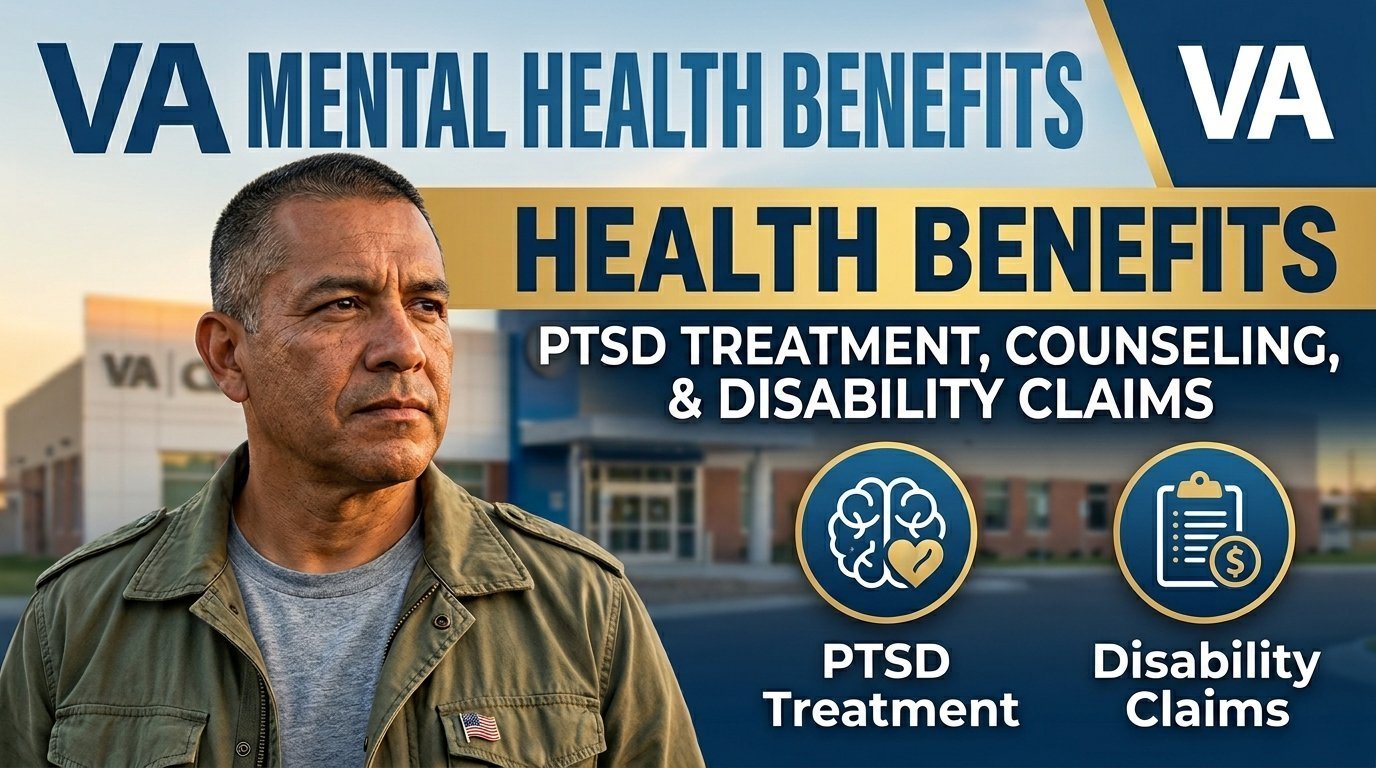
If you served in the United States military, your VA mental health benefits are some of the most comprehensive in the country—and yet a 2023 RAND study estimated that fewer than half of veterans who screened positive for PTSD, depression, or hazardous alcohol use received any treatment in the prior year. Some did not know what they were eligible for. Others were waiting for an appointment that never seemed to come. Many simply did not know where to start.
This guide explains exactly how VA mental health care works in 2026: who qualifies, what services are covered, how to file a VA disability claim for PTSD or depression, what to do when you have been denied, and how to use community care if the wait at your VA is too long.
Who Qualifies for VA Mental Health Care
Most veterans who served on active duty and were not dishonorably discharged are eligible for at least some VA health care. For mental health specifically, the eligibility rules are even broader. Under the Commander John Scott Hannon Veterans Mental Health Care Improvement Act and subsequent expansions, the following groups can access free VA mental health services regardless of service-connected status:
- Combat veterans within five years of separation
- Veterans who experienced military sexual trauma (MST), at any time after service
- Former service members at risk of suicide, under the COMPACT Act
- National Guard and Reserve members with qualifying federal active duty
- Veterans with an Other Than Honorable discharge in many circumstances, particularly when MST or combat exposure is documented
If you are unsure whether you qualify, the fastest path is to walk into any VA medical center and ask to speak with the Mental Health Intake Coordinator. Eligibility for crisis care is essentially universal under the COMPACT Act—you can access up to 90 days of free emergency mental health care at any VA or non-VA facility, even if you have never been enrolled.
What VA Mental Health Care Actually Includes
Once you are enrolled, the VA covers a remarkably broad spectrum of mental health treatment:
- Outpatient therapy with licensed psychologists, social workers, and counselors
- Psychiatric medication management including SSRIs, mood stabilizers, and prazosin for trauma-related nightmares
- Evidence-based PTSD therapies: Cognitive Processing Therapy (CPT), Prolonged Exposure (PE), and EMDR
- Substance use treatment including medication-assisted treatment for alcohol and opioid use disorder
- Inpatient psychiatric hospitalization at VA medical centers
- Residential rehabilitation programs through Domiciliaries and PTSD residential programs
- Vet Center counseling—a separate, more informal counseling network specifically for combat, MST, and bereavement
- Telehealth therapy through VA Video Connect
The financial side is equally favorable. Service-connected veterans typically pay nothing for mental health care. Even non-service-connected veterans in higher priority groups usually have small or no copays for therapy and psychiatric appointments. Compare this to the $150–$250 per session that the same care often costs on the civilian market, and the value is substantial.
How to File a VA Disability Claim for PTSD
A VA disability rating for PTSD entitles you to monthly tax-free compensation, additional access to care, and in many states, property tax exemptions and tuition benefits. Ratings range from 0 percent to 100 percent in 10-percent increments. As of 2026, a 70 percent PTSD rating pays approximately $1,759 per month for a single veteran, and 100 percent pays roughly $3,831.
To file a successful PTSD disability claim, you generally need three things:
- A current diagnosis of PTSD by a qualified clinician (a VA psychologist or psychiatrist is ideal, but a private provider works if their report meets DSM-5 criteria)
- An in-service stressor—the event that caused the PTSD. This can be combat, MST, fear of hostile activity, training accidents, or non-combat traumatic events documented in your service records
- A medical nexus opinion linking the current symptoms to the in-service stressor
For combat-related PTSD, the VA presumes the stressor occurred if your records show combat service—you do not need to prove the specific firefight or IED. For MST, the VA accepts “markers” like sudden requests for transfer, performance changes, or relationship breakdowns as supporting evidence even when no formal report was filed.
What to Do If Your Claim Is Denied
Many initial PTSD claims are denied or under-rated. Do not give up. You have three appeal options under the AMA framework:
- Higher-Level Review—a senior reviewer re-examines the same evidence
- Supplemental Claim—you submit new and relevant evidence, such as an Independent Medical Opinion or buddy statements
- Board Appeal—a Veterans Law Judge reviews your case, with or without a hearing
An accredited Veterans Service Officer (VSO) at the American Legion, DAV, or VFW will help you file appeals at no charge. For complex appeals, a VA-accredited attorney can represent you on a contingency basis—they only get paid (typically 20 percent of past-due benefits) if you win.
Community Care: When the VA Wait Is Too Long
Under the MISSION Act, if the VA cannot schedule you within 20 days for outpatient mental health care, or if the drive time exceeds 30 minutes, you are eligible for VA Community Care. The VA pays a private provider in your community to deliver the same therapy or psychiatry, with no out-of-pocket cost to you for service-connected conditions.
Ask your VA primary care provider or mental health intake coordinator for a Community Care referral. Once approved, you can choose any provider in the VA’s contracted network. This is particularly useful for veterans in rural areas or those who want a specialist the local VA does not employ, such as an EMDR-certified clinician.
Vet Centers: A Different Door Into Care
Vet Centers are a separate program from VA medical centers. They are smaller, community-based offices that offer free, confidential counseling for combat veterans, MST survivors, bereaved military families, and drone crew members. There is no need to enroll in VA health care to use one. Vet Centers do not share notes with the VA disability system, which makes some veterans more comfortable opening up.
Crisis Resources
The Veterans Crisis Line is available 24/7. Dial 988 and press 1, text 838255, or chat at VeteransCrisisLine.net. Confidential, staffed by veterans and clinicians trained in military culture. You do not need to be enrolled in VA care to call.
Getting Started Today
If you have not enrolled in VA health care, apply online at VA.gov/health-care/apply or in person at any VA medical center. Bring your DD-214. Within a few weeks you will receive a Veterans Health ID Card and can schedule your first mental health intake appointment.
If you are already enrolled but have not used mental health services, send a secure message through MyHealtheVet asking for a mental health referral. You will usually be contacted within a few business days for a phone screening, then offered an intake appointment with a therapist or psychiatrist.
The benefits you earned through service are not symbolic. They are substantial, evidence-based, and waiting for you. The hardest part is starting—everything after that gets easier.
This article is for informational purposes only and is not medical, legal, or financial advice. Eligibility and benefit amounts change—always confirm current rules with the VA at VA.gov or with an accredited Veterans Service Officer.