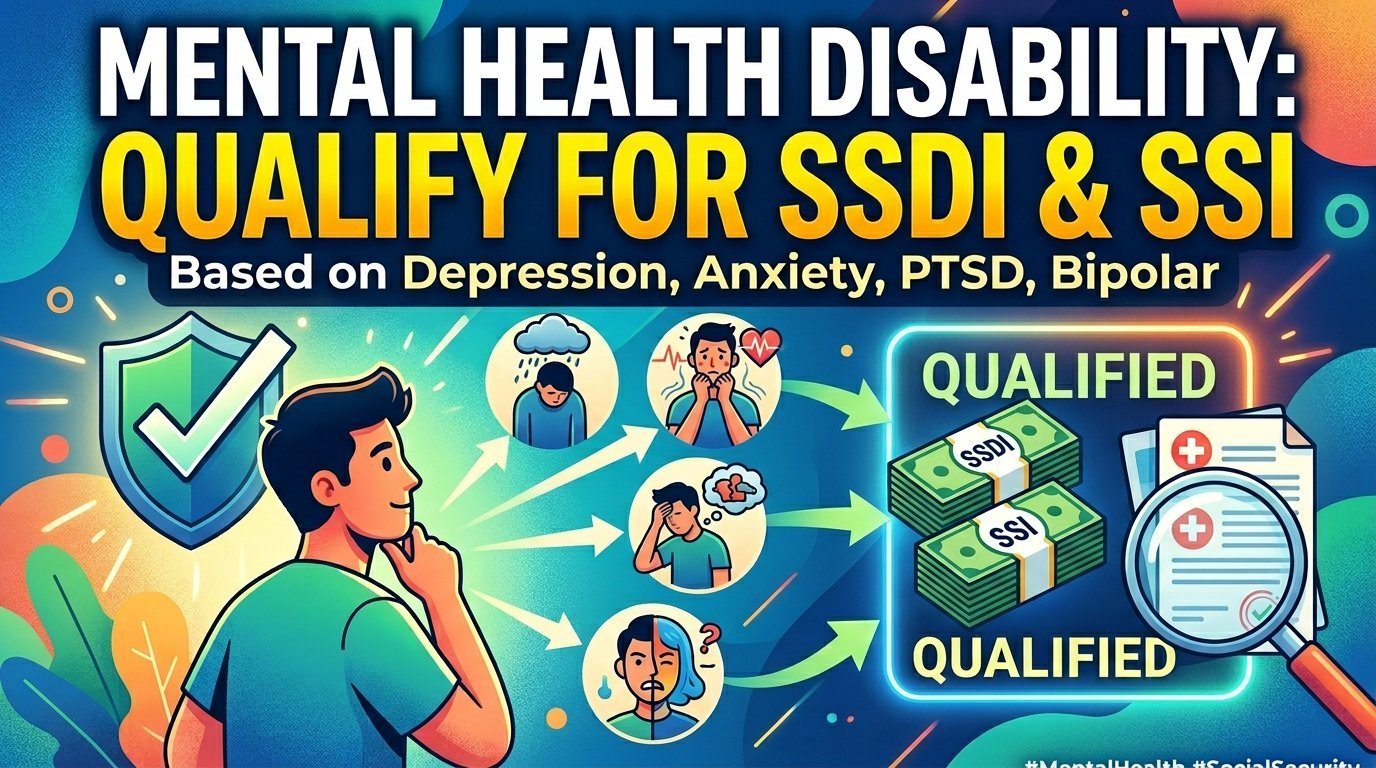
If a mental health condition makes it impossible for you to hold a job, you may qualify for monthly federal disability payments. The two largest programs—Social Security Disability Insurance (SSDI) and Supplemental Security Income (SSI)—collectively pay benefits to roughly 1.5 million Americans whose primary disabling condition is a mental disorder. Yet the initial denial rate for mental-health-based claims is around 65 percent. The system rewards documentation, persistence, and understanding the very specific way the Social Security Administration evaluates psychiatric disability.
This guide walks through how to qualify for mental health disability benefits, which conditions are evaluated, what evidence you need, why most people get denied the first time, and how to win on appeal.
SSDI vs. SSI: Two Different Programs
Both programs pay monthly benefits for total disability, but they have different eligibility rules.
SSDI is an insurance program. You qualify based on your work history—generally, you need 40 work credits, with 20 earned in the last 10 years. The 2026 average SSDI payment is approximately $1,580 per month, and after 24 months on SSDI you become eligible for Medicare regardless of age.
SSI is a needs-based program. You qualify if you have very limited income and assets—currently under $2,000 for an individual, $3,000 for a couple. The federal SSI payment in 2026 is up to $967 per month for an individual. SSI recipients usually qualify automatically for Medicaid.
Many people qualify for both at reduced amounts (called concurrent benefits). The medical disability standard is identical for both programs.
Mental Health Conditions That Qualify
The Social Security Administration evaluates mental disorders under Listing 12, which covers eleven categories. The most commonly approved are:
- 12.04 Depressive, Bipolar, and Related Disorders—major depression, persistent depressive disorder, bipolar I and II
- 12.06 Anxiety and Obsessive-Compulsive Disorders—generalized anxiety, panic disorder, agoraphobia, OCD
- 12.15 Trauma- and Stressor-Related Disorders—PTSD, complex PTSD, acute stress disorder
- 12.03 Schizophrenia Spectrum and Other Psychotic Disorders
- 12.05 Intellectual Disorder
- 12.08 Personality and Impulse-Control Disorders—borderline, paranoid, antisocial
- 12.10 Autism Spectrum Disorder
- 12.11 Neurodevelopmental Disorders—ADHD, learning disabilities
- 12.13 Eating Disorders—anorexia nervosa, bulimia, binge eating disorder
The Two-Part Test: Diagnosis Plus Functional Limitation
Having a diagnosis is not enough. To meet a Listing, you must show both:
Paragraph A—medical documentation of the disorder, with specific symptoms named in the listing. For Listing 12.04 depression, for example, this means at least five symptoms from a defined list (depressed mood, diminished interest, appetite change, sleep disturbance, psychomotor changes, fatigue, worthlessness, concentration problems, suicidal thoughts).
Paragraph B—extreme limitation in one, or marked limitation in two, of these four areas:
- Understanding, remembering, or applying information
- Interacting with others
- Concentrating, persisting, or maintaining pace
- Adapting or managing oneself
If your symptoms have been present for at least two years and you have only achieved marginal adjustment with the help of structured treatment, ongoing therapy, or a highly supportive living environment, you may qualify under Paragraph C instead.
Building Strong Medical Evidence
The single biggest mistake applicants make is filing without enough recent treatment records. Social Security wants to see consistent, documented care over months or years from acceptable medical sources—psychiatrists, psychologists, and (for some claims) licensed clinical social workers and licensed mental health counselors.
Helpful evidence includes:
- Therapy session notes describing functional impairment, not just feelings
- Psychiatric medication management notes showing what has been tried and what has failed
- Hospitalization records, IOP/PHP discharge summaries
- Standardized assessments such as the PHQ-9, GAD-7, PCL-5, or formal psychological testing
- A Mental Residual Functional Capacity (MRFC) form completed by your treating psychiatrist or psychologist—arguably the single most important document for winning a mental health disability claim
The Substantial Gainful Activity Limit
To be considered disabled, you must be unable to perform substantial gainful activity (SGA). In 2026, SGA is generally $1,620 per month for non-blind individuals. Earning above SGA from work—even part-time—will result in denial regardless of how severe your symptoms are. Trial Work Period rules allow some return-to-work testing once benefits begin, but the application stage is strict.
Why Most Initial Claims Are Denied
Common reasons for denial include:
- Insufficient medical evidence—sporadic treatment, no recent records
- Functional limitations described in vague terms (“I’m depressed”) rather than specific examples (“I cannot leave my apartment more than once per week”)
- Failure to attend a Consultative Examination scheduled by the Disability Determination Services
- Working at or above SGA levels during the application period
- Substance use that complicates the disability picture without proper documentation of materiality—whether the impairment would still be disabling if substance use stopped
The Appeals Process: Where Most Cases Are Won
If denied, you have 60 days to appeal. There are four levels:
- Reconsideration—a different examiner reviews the same file, with any new evidence
- Administrative Law Judge (ALJ) hearing—the most successful stage, where roughly half of applicants win when properly represented
- Appeals Council review
- Federal court
Most successful claimants reach approval at the ALJ hearing stage. Hire a Social Security disability attorney or accredited representative—they work on contingency, capped at 25 percent of past-due benefits with a federal maximum (currently $9,200 in 2026). You pay nothing if you do not win.
While You Wait: What to Do During the 6–24 Month Process
The application process is long. Take these steps to protect yourself:
- Keep attending therapy and psychiatric appointments—gaps in care hurt your case
- Apply for Medicaid in your state for interim health coverage
- Apply for SNAP, LIHEAP, and emergency rental assistance through 211 or local nonprofits
- If you are working below SGA, document carefully and report all earnings
- Keep a symptom journal—date-stamped notes about bad days, missed appointments, panic attacks, hospitalizations
After Approval: What to Expect
If approved, you will receive a back-pay lump sum covering the months between your established onset date and approval, then monthly checks going forward. Mental health disability cases are subject to Continuing Disability Reviews every 3 to 7 years, so continue your treatment relationship. The reviews look at whether your condition has medically improved enough to return to work.
Programs like Ticket to Work let you test returning to employment without immediately losing benefits, which is particularly valuable for people whose conditions wax and wane.
A Final Note
Applying for mental health disability is exhausting, especially when the very symptoms that disabled you make paperwork feel impossible. Be patient with yourself, lean on a representative, and remember that statistics favor persistence. People who appeal to the ALJ stage win significantly more often than those who give up after the first denial.
This article is for informational purposes only and is not legal, medical, or financial advice. Disability rules and benefit amounts change. Verify your specific situation with SSA.gov or a licensed disability attorney.