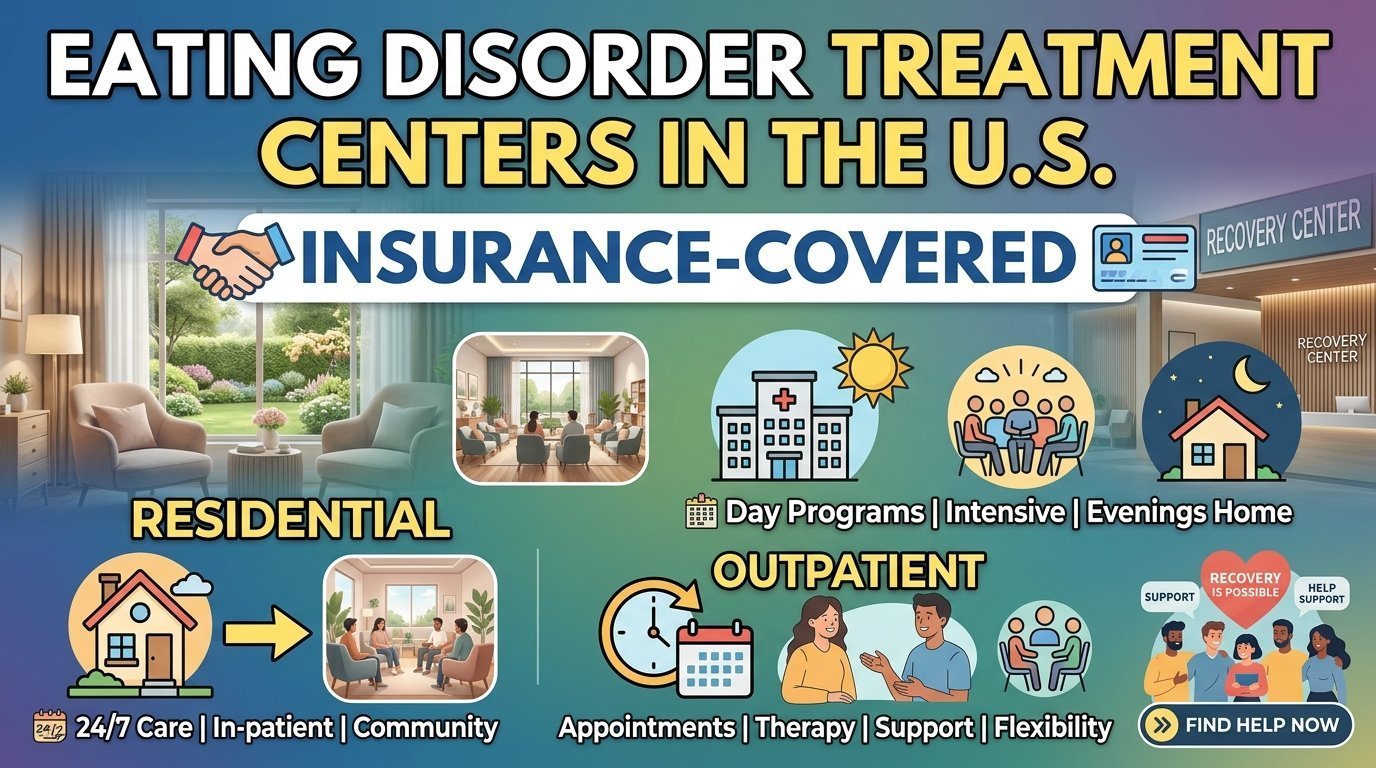
Eating disorders have the highest mortality rate of any mental illness, and yet only a fraction of the estimated 28 million Americans who will experience one in their lifetime ever receive specialized treatment. The reasons are familiar: cost, fear, denial, long waitlists, and the misperception that eating disorder treatment is reserved for adolescent girls in extreme physical danger.
This guide explains how the U.S. system of eating disorder treatment centers actually works in 2026: the levels of care from outpatient to residential, what insurance is required to cover, how to evaluate a treatment center before admission, and what realistic costs look like for people without insurance.
Disorders Treated and Why Specialized Care Matters
Specialized programs treat anorexia nervosa, bulimia nervosa, binge eating disorder, ARFID (avoidant/restrictive food intake disorder), OSFED (other specified feeding or eating disorder), and orthorexia. General mental health clinicians often lack training in the medical complications, refeeding protocols, and exposure-based interventions these conditions require. A general therapist can be valuable as part of a team, but the structural framework of eating disorder treatment usually needs to come from a multidisciplinary specialist program.
The Levels of Care
The Academy for Eating Disorders defines six levels of care. From least to most intensive:
1. Outpatient
One to two appointments per week with some combination of a therapist, a registered dietitian, and a medical provider or psychiatrist. Appropriate when medical status is stable, weight is not severely compromised, and the person can maintain basic structure independently.
2. Intensive Outpatient (IOP)
Three to five days per week, three hours per day. Includes group therapy, supervised meals, and individual sessions. People live at home and continue working or attending school.
3. Partial Hospitalization (PHP) / Day Treatment
Five to seven days per week, six to ten hours per day. Multiple supervised meals, intensive therapy, medical monitoring. Often a step down from residential or a step up from IOP.
4. Residential Treatment
Live-in care 24 hours per day at a non-hospital facility. Average length of stay is 30 to 90 days. All meals are supervised. Includes therapy, dietary work, family programming, and psychiatric care.
5. Acute Inpatient (Medical or Psychiatric Hospital)
For medical stabilization—dangerously low weight, electrolyte imbalances, suicidality, or refeeding requirements that need close medical monitoring.
6. Specialized Medical-Behavioral Inpatient
Hospital-based units that combine intensive medical care with eating disorder programming. ACUTE Center for Eating Disorders in Denver and the Johns Hopkins Eating Disorders Program are well-known examples.
What Insurance Is Required to Cover
Under the Mental Health Parity and Addiction Equity Act, group health plans cannot impose more restrictive limits on eating disorder treatment than on comparable medical care. In practice this means insurers must cover medically necessary treatment at the appropriate level of care—though they often resist.
Most commercial insurance plans, ACA Marketplace plans, and Medicaid plans cover:
- Outpatient therapy and dietitian visits with an eating disorder diagnosis on the claim
- IOP and PHP at in-network and many out-of-network programs
- Residential treatment when medical necessity criteria are met
- Inpatient hospitalization for medical stabilization
Be ready for concurrent reviews—the insurer will reauthorize each week of residential or PHP care based on continued medical necessity. Treatment centers handle this for you, but they will need updated weights, vitals, and clinical notes to keep authorization going.
The Real Cost of Residential Treatment
Without insurance, residential eating disorder treatment in the United States typically costs $1,500 to $2,500 per day. A 60-day residential stay can therefore approach $150,000. PHP runs $1,000 to $1,500 per day. IOP is $300 to $500 per day. Outpatient sessions are $150 to $300 each.
If you have insurance, your costs are capped by your deductible, copays, and out-of-pocket maximum. With a typical Marketplace plan, hitting your annual out-of-pocket maximum (around $9,200 in 2026 for an individual) is realistic during a residential stay, after which the insurer covers the rest of the year.
How to Evaluate a Treatment Center
Not all centers are equal. Before admission, ask:
- Accreditation: Is the program Joint Commission or CARF accredited?
- Staffing: What is the staff-to-patient ratio? Are physicians and dietitians on site daily? Is there 24-hour nursing?
- Evidence-based therapies: Do they use CBT-E, FBT (for adolescents), DBT, or exposure-based interventions?
- Family involvement: Is family-based treatment offered? How is family programming structured?
- Medical capacity: Can they manage refeeding for severely underweight patients, or only stable ones?
- Co-occurring care: Can they treat trauma, depression, or substance use alongside the eating disorder?
- Length-of-stay philosophy: Are decisions clinically driven or insurance driven?
- Transition planning: How do they coordinate step-down to PHP, IOP, and outpatient providers near your home?
Family-Based Treatment for Adolescents
For adolescents with anorexia or bulimia, Family-Based Treatment (FBT)—sometimes called the Maudsley approach—has the strongest evidence base of any outpatient model. FBT empowers parents to take charge of meals and refeeding while a specialized therapist coaches the family. For many adolescents, FBT can prevent the need for residential care entirely. Look for therapists certified through the Training Institute for Child and Adolescent Eating Disorders.
When Insurance Denies Coverage
If your insurer denies authorization, request the denial in writing along with the specific medical necessity criteria they applied. File an internal appeal within 180 days. If denied again, request an external review through your state insurance commissioner. For employer-sponsored ERISA plans, you can also file a parity complaint with the Department of Labor. Most treatment centers have utilization-review staff who fight these battles routinely; let them help.
Free and Low-Cost Resources
If treatment is unaffordable even with insurance, organizations that may help include:
- Project HEAL—treatment scholarships and a national clinician network
- The Alliance for Eating Disorders Awareness Helpline—free referrals at 1-866-662-1235
- NEDA Helpline—chat-based support and treatment navigation
- F.E.A.S.T.—free family-to-family support and peer mentorship
- State Medicaid coverage—most states cover outpatient and IOP, and many cover residential under medical necessity criteria
Recovery Is Possible
Eating disorders are serious illnesses, but they are also among the most treatable when care is matched to severity and continued long enough. Lifetime recovery rates for anorexia and bulimia are estimated at 60 to 70 percent. The earlier care begins, the better the prognosis—if you are wondering whether things are bad enough to seek help, that is your answer.
This article is for informational purposes only and is not medical advice. If you or someone you love is in a medical crisis, contact a healthcare provider or visit an emergency room. The 988 Suicide and Crisis Lifeline is available 24/7.