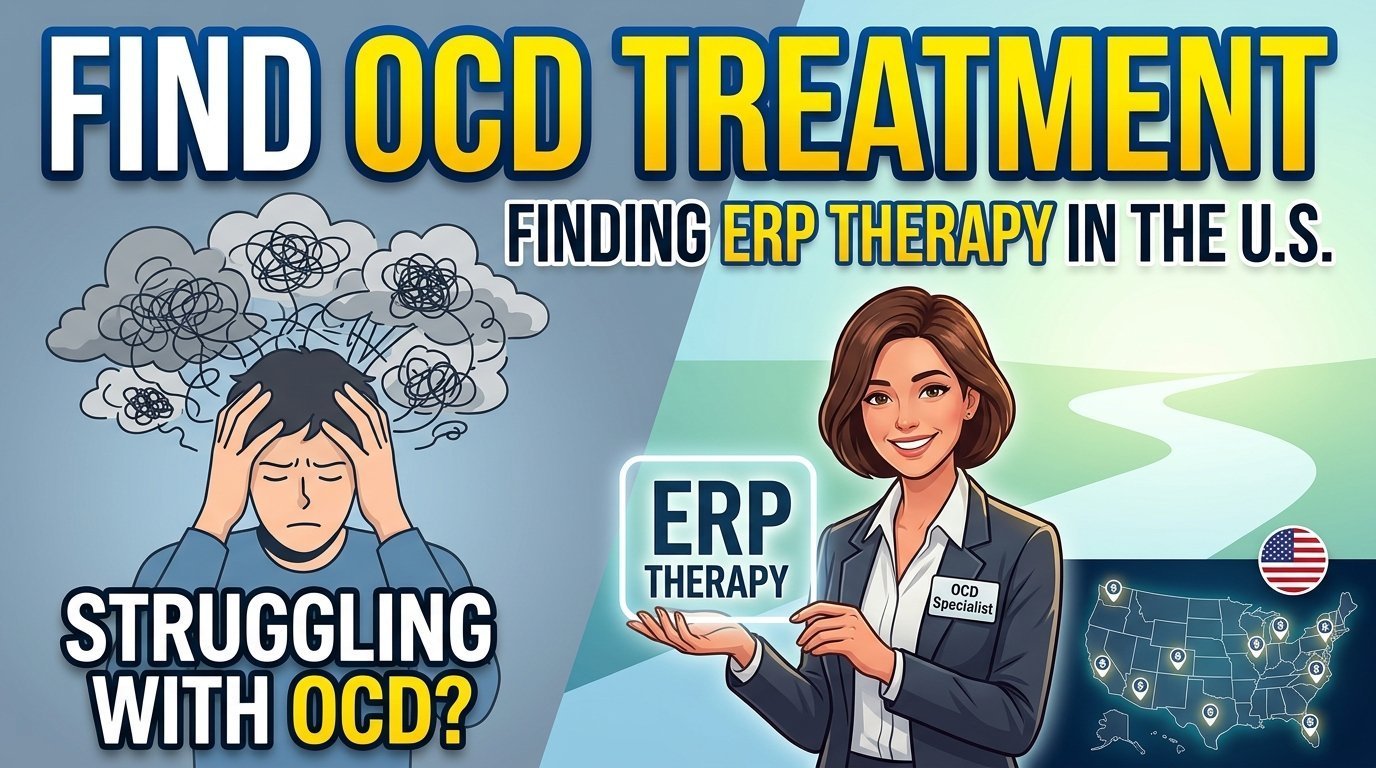
About 2.3 percent of American adults will meet criteria for obsessive-compulsive disorder at some point in their lives. Yet the average person with OCD waits 11 to 17 years between symptom onset and effective treatment—not because the right treatment does not exist, but because most therapists are not trained to deliver it. The therapy that actually works for OCD is Exposure and Response Prevention (ERP), and finding a clinician who does it well is the single most important decision a person with OCD will make.
This guide explains what ERP is, why standard talk therapy often fails OCD, how to find a properly trained OCD specialist, what insurance is required to cover, and what to expect from intensive treatment when weekly therapy is not enough.
Why Generic Therapy Often Fails OCD
OCD is fundamentally a disorder of paradox. The well-meaning advice we give for normal worry—reassure yourself, talk it through, examine the evidence—tends to make OCD worse. The brain treats reassurance as a compulsion, which strengthens the obsessive cycle.
Therapists trained only in general cognitive behavioral therapy or supportive talk therapy frequently spend sessions analyzing the “meaning” of obsessions or providing reassurance that fears will not come true. For OCD, both interventions inadvertently feed the disorder. ERP, by contrast, is counterintuitive: it asks the patient to deliberately face the feared situation while refusing to perform the compulsion that normally relieves the anxiety.
What ERP Actually Looks Like
ERP has three core components:
- Identifying obsessions and compulsions—the therapist works with you to map your unique OCD: contamination, harm, religious scrupulosity, sexual orientation, relationship, perfectionism, “just right” sensations, or rumination
- Building an exposure hierarchy—a graded list from mildly distressing situations to the most feared scenarios
- Practicing exposures while preventing the response—you deliberately encounter the trigger and refrain from the compulsion (washing, checking, mental review, reassurance seeking, avoidance)
A session might involve touching a doorknob and refusing to wash, sitting with an intrusive thought without performing a mental ritual, leaving the house without checking the stove, or watching a video that triggers fear. The anxiety rises sharply, then falls—and over many repetitions, the brain learns that the feared outcome does not happen and the compulsion is not necessary.
Modern ERP often draws on inhibitory learning theory, which emphasizes building tolerance for uncertainty rather than habituating until anxiety drops to zero. The goal is functional—living a meaningful life despite obsessions—not necessarily eliminating every intrusive thought.
How to Find a Properly Trained OCD Specialist
The most reliable way is to use directories curated by OCD-specific organizations:
- International OCD Foundation (IOCDF) at iocdf.org maintains a Find Help directory of clinicians who have completed advanced ERP training, including the IOCDF Behavior Therapy Training Institute (BTTI)
- Association for Behavioral and Cognitive Therapies (ABCT) “Find a CBT Therapist” tool
- NOCD—a national virtual OCD-specialist platform that accepts most major insurance plans
- University-affiliated OCD Specialty Clinics—Columbia, Penn, Mass General, UCLA, University of Michigan, Stanford, and others run dedicated OCD programs that accept self-referrals
When you call, ask: “What percentage of your caseload is OCD? Have you completed BTTI or comparable advanced ERP training? Do you do exposures in session, including outside the office when needed? How do you handle reassurance-seeking?” A specialist will answer concretely.
When Outpatient ERP Is Not Enough
For severe OCD, a weekly hour of therapy is rarely enough. Higher levels of care include:
- Intensive Outpatient (IOP)—9 to 15 hours of weekly programming
- Partial Hospitalization (PHP)—30 to 40 hours per week, 6 hours per day, with structured exposures
- Residential OCD treatment—live-in 30 to 90 day programs at specialized centers like the McLean OCD Institute, Rogers Behavioral Health, and the OCD Institute at Lindner Center of HOPE
- Inpatient hospitalization—reserved for cases with severe self-neglect or co-occurring suicidality
Insurance is required to cover these levels of care under parity rules when medical necessity criteria are met. A multi-week stay at a specialized residential program can produce more progress than years of weekly therapy.
Medications for OCD
SSRIs are first-line medication for OCD. Effective options include fluoxetine, sertraline, fluvoxamine, paroxetine, and escitalopram. OCD typically responds at higher doses than those used for depression, and full response can take 8 to 12 weeks. Clomipramine, an older tricyclic, has strong evidence but more side effects and is often saved for treatment-resistant cases. For severe, medication-resistant OCD, augmentation strategies may include low-dose atypical antipsychotics, glutamate modulators, or referral for deep brain stimulation at academic centers.
The combination of ERP plus an SSRI generally outperforms either alone. Medication decisions should be made with a psychiatrist familiar with OCD pharmacology, not a primary care prescriber unless they have significant experience.
Subtypes That Get Misdiagnosed
OCD often presents in ways that even experienced clinicians miss:
- Pure-O / Primarily Obsessional OCD—mental compulsions and rumination without visible behaviors. Often misdiagnosed as generalized anxiety
- Sexual Orientation OCD (SO-OCD) and Harm OCD—intrusive thoughts about identity or causing harm. Often shamed and silenced rather than treated
- Relationship OCD (ROCD)—persistent doubts about a partner or one’s feelings. Often treated as a relationship problem rather than OCD
- Scrupulosity—religious or moral OCD, often misread as devout faith
- Pediatric Acute-Onset Neuropsychiatric Syndrome (PANS)—sudden-onset OCD in children, sometimes following infection
What Insurance Is Required to Cover
Under federal parity rules, ACA-compliant plans, Medicaid, Medicare, and most employer plans cover:
- Outpatient therapy with a licensed clinician—ERP is reimbursable as cognitive behavioral therapy
- Psychiatric medication management for SSRIs and adjuncts
- IOP, PHP, and residential treatment for OCD when medical necessity criteria are met
- Out-of-network reimbursement when a properly trained ERP specialist is not available in network
Insurance often initially denies higher levels of care. Treatment centers will appeal, but you can also file a parity complaint with your state insurance commissioner if the same condition would have been authorized for an equivalent medical condition like an autoimmune disease.
A Final Note
OCD is among the most treatable psychiatric conditions when matched with the right therapy. The discomfort is real and the progress takes work, but a person who completes a full course of ERP therapy typically experiences a 60 to 80 percent reduction in symptoms within months. The lost decades many people spend in ineffective treatment are not necessary. Find a specialist, ask the hard questions, and commit to the work—recovery is closer than the disorder lets you believe.
This article is for informational purposes only and is not medical advice. OCD is a serious condition that requires individualized care from licensed clinicians.