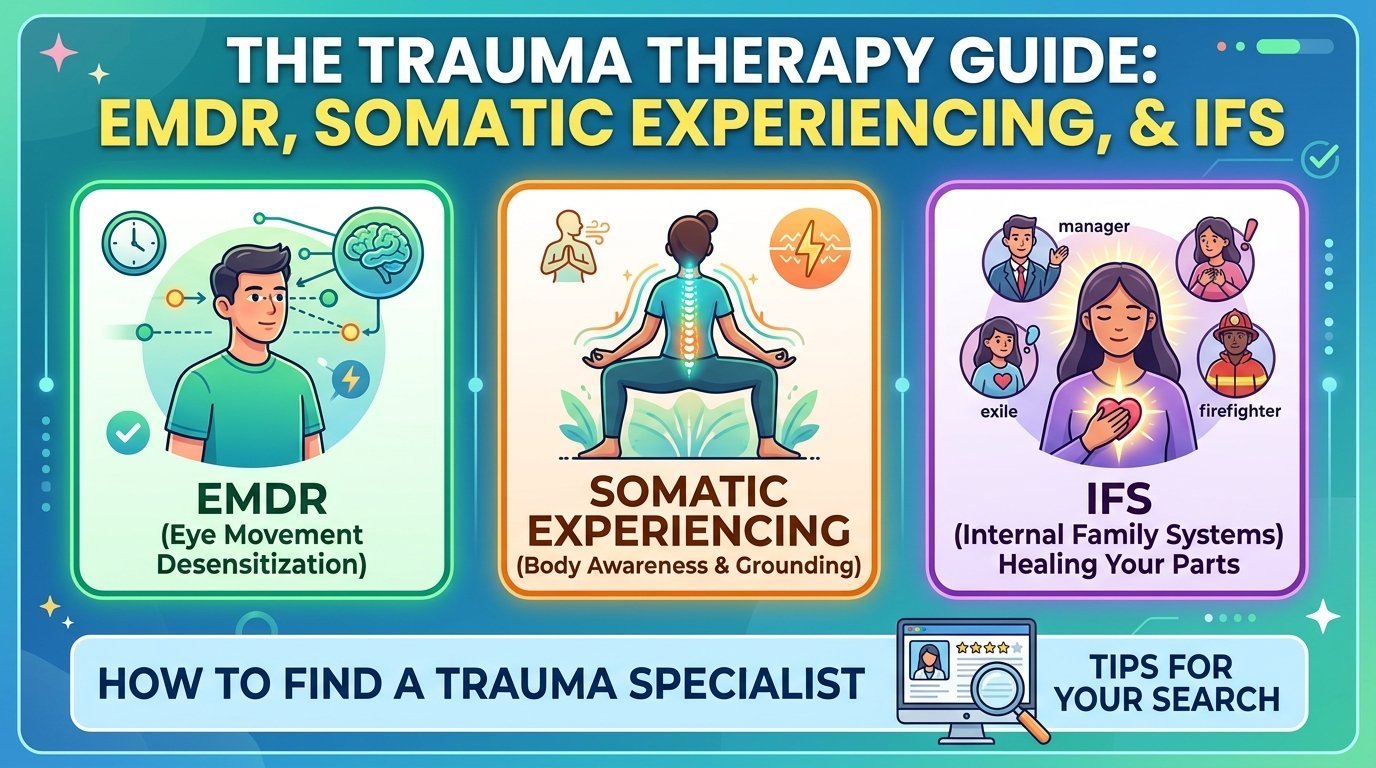
For people whose distress traces back to trauma—a single overwhelming event or years of repeated harm—standard talk therapy alone often falls short. The body remembers what the mind has tried to file away, and a one-hour conversation about insight rarely changes the way a nervous system reacts to a smell, a sound, or a touch. Modern trauma therapy uses different tools: EMDR, somatic experiencing, and internal family systems (IFS). Each works on the underlying physiology of trauma rather than just the story.
This guide explains how each modality actually works, who is a good candidate for which, and how to find a credentialed practitioner without ending up with a weekend-trained clinician charging premium rates.
EMDR: Eye Movement Desensitization and Reprocessing
EMDR therapy was developed in the late 1980s by Francine Shapiro and is now endorsed by the American Psychiatric Association, the World Health Organization, and the U.S. Department of Veterans Affairs as a first-line treatment for PTSD. It uses bilateral stimulation—side-to-side eye movements, alternating taps, or tones—while the client briefly recalls a distressing memory.
An EMDR session follows a structured eight-phase protocol: history-taking, preparation and resourcing, target identification, desensitization, installation of a positive belief, body scan, closure, and reevaluation. Most courses of EMDR for single-incident trauma run 6 to 12 sessions. Complex or developmental trauma typically requires longer treatment with extra preparation work.
Look for clinicians credentialed by the EMDR International Association (EMDRIA). There are two relevant designations: EMDR-trained (completed an EMDRIA-approved basic training of about 50 hours plus 10 hours of consultation) and EMDR Certified (completed advanced consultation, additional training, and at least 50 EMDR sessions). Certified clinicians have meaningfully more experience.
Somatic Experiencing: Resolving Trauma Through the Body
Somatic Experiencing (SE), developed by Peter Levine, focuses on the survival energy that gets “stuck” in the body when a fight, flight, or freeze response cannot complete. Instead of asking the client to relive a memory, an SE therapist tracks bodily sensations—tightness, trembling, temperature changes, breath patterns—and helps the nervous system gradually release what it has been holding.
SE is particularly useful for:
- Medical or surgical trauma
- Car accidents and physical injuries
- Birth trauma in infants and mothers
- Chronic pain and unexplained somatic symptoms
- Clients who feel overwhelmed by traditional verbal trauma processing
- People with significant dissociation who need slower pacing
SE practitioners complete a three-year training through Somatic Experiencing International. Look for the credential SEP (Somatic Experiencing Practitioner), which signals completion of the full curriculum. Some massage therapists, occupational therapists, and bodyworkers also hold the SEP credential, but for trauma processing you generally want a licensed mental health clinician with the additional SE training.
Internal Family Systems (IFS): The Parts Approach
Internal Family Systems, developed by Richard Schwartz, frames the mind as a system of distinct “parts” led by a core Self that is innately calm, curious, and compassionate. Trauma drives parts into protective roles: managers control daily life to prevent triggering, firefighters intervene when distress breaks through (sometimes with substances, dissociation, or self-harm), and exiles hold the most painful feelings.
IFS therapy involves befriending these parts in dialogue, understanding their protective intentions, and ultimately allowing the Self to bring relief and healing to the wounded exiles. The model resonates with people who experience inner conflict, harsh self-criticism, addictive coping, or developmental trauma where multiple roles formed early in life.
The IFS Institute offers tiered certification: Level 1 training is roughly 100 hours, Level 2 adds another 50, and Level 3 is for advanced specialization. Certified practitioners are listed in the IFS Institute directory at ifs-institute.com. IFS has been recognized by the National Registry of Evidence-Based Programs and Practices and has growing research support.
Choosing Among Modalities
No single modality is universally superior—research shows comparable outcomes for trauma-focused therapies when delivered competently. Some general guidance:
- Single-incident adult trauma—EMDR is fast and well-supported
- Heavy somatic symptoms or medical trauma—Somatic Experiencing often fits better
- Complex developmental trauma, dissociation, or strong inner conflict—IFS, often combined with one of the others
- Combat-related PTSD—Cognitive Processing Therapy, Prolonged Exposure, or EMDR are first line
- Veterans with severe symptoms—the VA covers all three modalities; ask about evidence-based PTSD program enrollment
Many therapists are trained in two or even all three modalities and weave them based on what is needed in the moment.
What Insurance Covers
EMDR, somatic experiencing, and IFS are not separate billing codes—they are delivered by licensed clinicians under standard psychotherapy CPT codes (90834 or 90837 for individual psychotherapy). Insurance covers them just like any other therapy with the appropriate diagnosis code (often F43.10 for PTSD or F43.12 for chronic PTSD).
Out-of-network coverage matters here. Trauma specialists with advanced training are often in private practice and not on insurance panels. Use your out-of-network benefits: pay the therapist directly, then submit a superbill for partial reimbursement. Many people recoup 40 to 70 percent of session costs after meeting their out-of-network deductible.
Intensive Trauma Therapy: An Alternative to Weekly Sessions
For trauma survivors who want faster progress, an emerging model is intensive outpatient trauma therapy: 2- to 5-day intensives with one therapist, sometimes followed by maintenance sessions. Programs like the Trauma Recovery Project, Onsite Workshops, the Meadows, and dozens of EMDR-intensive private practices offer this format. Costs are higher per day but cumulative time and progress can be greater than a year of weekly therapy.
Red Flags When Vetting a Trauma Therapist
Beware practitioners who:
- Are not licensed mental health professionals (life coaches, energy workers, untrained “trauma facilitators”)
- Cannot describe their training or certification level when asked directly
- Promise rapid “cures” through unproven adjuncts (proprietary devices, supplements they sell, unsupervised psychedelics)
- Skip the preparation and resourcing phase to jump immediately into trauma processing
- Refuse to coordinate with your prescribing psychiatrist or primary care provider
A Final Note
The science of trauma treatment has advanced dramatically in the past two decades. EMDR, somatic experiencing, and IFS each offer real, well-supported paths through the symptoms that talk therapy alone often cannot reach. Finding a properly credentialed clinician takes effort, but the payoff is therapy that changes how your body responds to the world—not just how you describe it.
This article is for informational purposes only and is not medical advice. Trauma is a serious clinical issue that warrants individualized care from a licensed mental health professional.