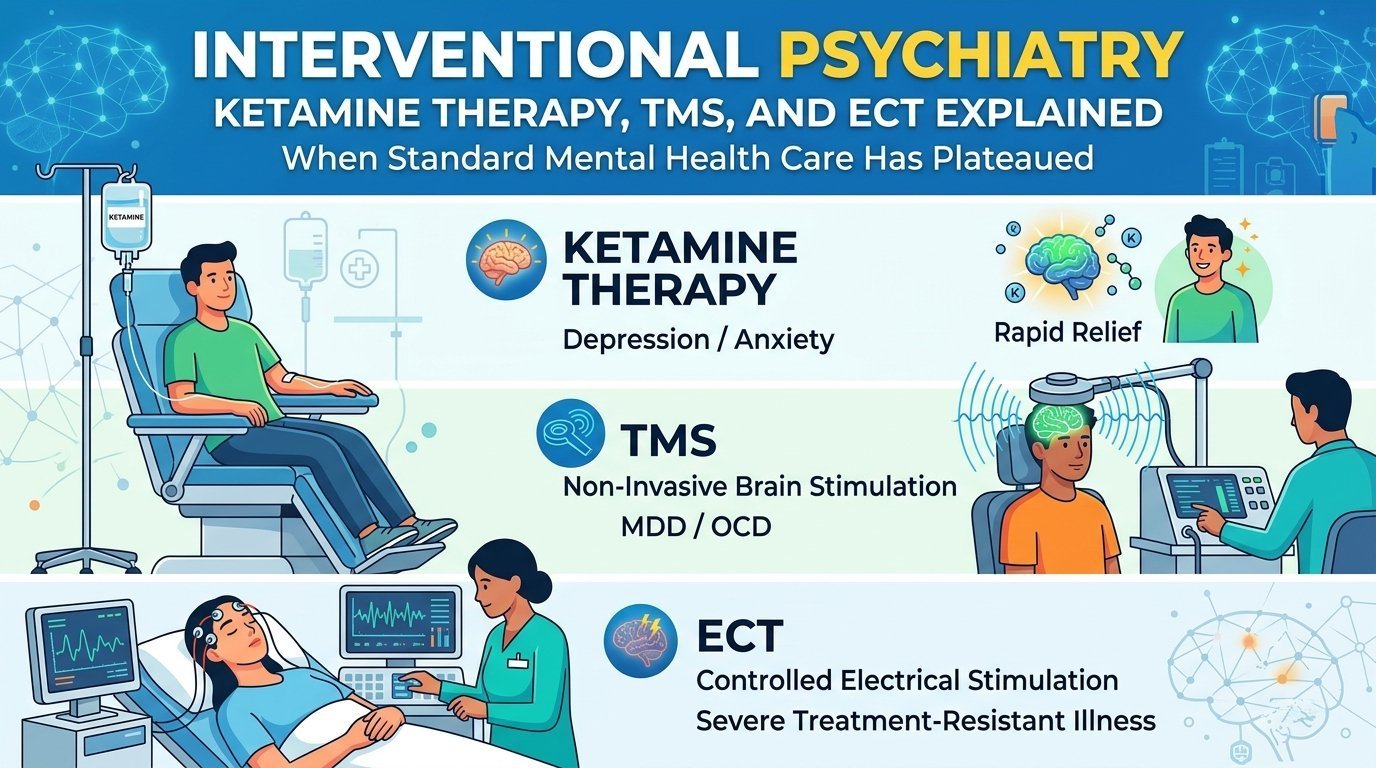
When Standard Mental Health Treatment Has Not Worked
Most patients with depression or anxiety respond to a combination of therapy and standard antidepressant medications. The combination produces meaningful improvement in roughly two-thirds of cases, and many of the remaining one-third respond to a second medication trial or a different therapeutic approach. A smaller but clinically significant group of patients does not respond adequately even after multiple medication trials. For these patients, interventional psychiatry offers a different category of treatment, including ketamine therapy, transcranial magnetic stimulation, electroconvulsive therapy, and several emerging modalities.
This guide describes the major interventional psychiatry options available in the United States in 2026, who they work for, what the experience is like, what insurance typically covers, and how patients access them. The category has expanded significantly in recent years, and patients whose previous mental health care has plateaued may not realise how many options now exist.
Ketamine Therapy
Ketamine has emerged over the past decade as a fast-acting treatment for treatment-resistant depression and several related conditions. The original form is intravenous ketamine, delivered in a clinical setting at sub-anaesthetic doses, typically over forty minutes per session, with a course of six initial sessions over two to three weeks followed by maintenance sessions as needed. A nasal spray version, esketamine, branded as Spravato, was FDA-approved in 2019 and is delivered in certified clinics under direct medical supervision.
The clinical effect of ketamine is unusual in psychiatry. Where traditional antidepressants take four to six weeks to begin working, ketamine often produces measurable improvement within hours to days. The effect is especially valuable for patients with active suicidal thoughts, where rapid reduction can be life-saving. The mechanism involves NMDA receptor antagonism and downstream effects on glutamate signalling and neuroplasticity, distinct from the serotonin-focused mechanisms of standard antidepressants.
Ketamine therapy is not a one-time treatment for most patients. The benefits typically last days to weeks after a session, and most protocols include maintenance sessions at decreasing frequencies over months. Insurance coverage has expanded but remains uneven. Spravato is covered by most major plans, including networks behind UnitedHealthcare therapists, Aetna, and Cigna, when criteria for treatment-resistant depression are documented. Off-label IV ketamine is less consistently covered, with many patients paying out of pocket at rates of four hundred to seven hundred dollars per session, although some clinics offer tiered pricing.
Transcranial Magnetic Stimulation
Transcranial magnetic stimulation, often abbreviated TMS, uses targeted magnetic pulses to stimulate specific regions of the brain, typically the dorsolateral prefrontal cortex. The patient sits in a chair, fully awake, while a clinician positions a coil against the head and delivers a course of pulses. Sessions last twenty to forty minutes, and a typical course involves daily sessions five days per week for six weeks.
TMS is FDA-approved for major depressive disorder that has not responded to at least one antidepressant, and increasingly for OCD, smoking cessation, and several other conditions. The clinical response rate for TMS in treatment-resistant depression is meaningful, with roughly half of patients showing significant improvement and a substantial fraction achieving full remission. The treatment has minimal side effects, no sedation, and patients can drive themselves to and from sessions.
Insurance coverage for TMS in treatment-resistant depression is now standard across major plans. Documentation typically requires evidence of failed trials of two or more antidepressants and ongoing depressive symptoms. The patient cost depends on plan design, with copays per session in the range of zero to seventy-five dollars after deductible. The full course of TMS typically meets the patient’s annual deductible if it had not already been met.
Electroconvulsive Therapy
Electroconvulsive therapy, ECT, is the oldest interventional psychiatric treatment and remains the most effective single intervention for severe treatment-resistant depression, severe mania, catatonia, and several other severe psychiatric conditions. ECT involves a brief electrical stimulation of the brain delivered under general anaesthesia, producing a controlled seizure that produces therapeutic effects through mechanisms that are still being characterised but include effects on neurotransmitter systems, neuroplasticity, and inflammation.
The cultural perception of ECT remains shaped by depictions from decades ago. Modern ECT is dramatically different from those depictions. The procedure occurs in an outpatient surgical suite or hospital, takes about an hour from check-in to discharge, uses anaesthesia and muscle relaxants, and produces only a brief subclinical seizure rather than the convulsions of older protocols. Side effects, particularly some short-term memory effects, are real but largely transient and have been reduced significantly with modern unilateral lead placement.
ECT remains the most effective treatment for severe and treatment-resistant depression, with response rates in the seventy to ninety percent range for appropriately selected patients. It is also the fastest-acting treatment available, with significant improvement often appearing within days of starting a course. Insurance coverage is universal across major plans, and ECT is one of the most clearly covered components of mental health care insurance. The treatment is delivered in academic medical centres and specialty psychiatric hospitals, with referrals coming through psychiatrists managing complex cases.
Emerging Treatments
Several treatments at the edge of clinical availability deserve mention. Psilocybin-assisted therapy, currently being studied in clinical trials and available in limited contexts in Oregon and several other jurisdictions, has shown promise for treatment-resistant depression, end-of-life distress, and substance use disorders. MDMA-assisted therapy for PTSD has progressed through advanced clinical trials and may receive FDA approval in the coming years.
Vagus nerve stimulation, deep brain stimulation, and several other neuromodulation techniques are available for narrowly selected patients, typically through academic medical centres. These treatments are reserved for patients whose conditions have not responded to multiple prior interventions and require careful evaluation by specialty centres.
Choosing Among the Options
The choice among interventional psychiatric treatments depends on the specific condition, the patient’s medical history, prior treatment responses, and clinical preferences. For treatment-resistant depression, TMS is often the first interventional option due to its low side-effect profile and broad insurance coverage. For depression with active suicidality, ketamine or Spravato may be considered first because of the rapid effect. For severe and treatment-resistant cases that have not responded to TMS or ketamine, ECT remains the gold standard.
Most patients accessing interventional mental health care reach these options through a referral from their existing psychiatrist. Specialty interventional psychiatry clinics increasingly accept self-referrals and conduct their own evaluations, although coordination with the patient’s existing psychiatrist remains important for continuity. The intake process typically includes a thorough review of prior treatments, current symptoms, medical history, and goals of treatment.
A Realistic Picture of Outcomes
Interventional psychiatry is not a guaranteed solution. Even ECT, the most effective single intervention, does not produce response in every patient. Ketamine, TMS, and other treatments work for some patients and not others. The probability of finding an effective treatment increases with the number of approaches tried, but no treatment works for everyone.
What interventional psychiatry offers is meaningful additional probability of recovery for patients who have not responded to standard treatment. For patients facing the prospect of years of unrelieved depression, the options described here represent serious clinical hope. Pursuing them requires coordination, patience, and willingness to engage with treatments that feel unfamiliar. The investment is often worth it.
This article is for educational purposes and does not constitute personalised medical advice. Discuss interventional treatment options with a psychiatrist familiar with your specific case. If you or someone you know is in crisis, call or text 988 in the United States.