The Largest Insurer of Mental Health Care You Probably Forgot
When Americans talk about insurance for mental health care, the conversation usually orbits commercial plans. Employer health benefits. ACA marketplace coverage. Networks like UnitedHealthcare therapists, Aetna, Cigna, and Blue Cross Blue Shield. Almost forgotten in that conversation is the country’s largest single source of mental health funding: Medicaid. The joint federal-state program covers more than ninety million Americans, including the population most likely to need significant mental health services and least likely to be able to afford them out of pocket.
This guide explains how Medicaid works for mental health care, who qualifies, what is covered in detail, and how to apply. The rules vary by state, sometimes dramatically, and that variation is itself one of the most important things to understand. The version of Medicaid available in California or New York is not the version available in Texas or Florida, and patients near a state border occasionally find that crossing the line changes their treatment options entirely.
How Medicaid Eligibility Actually Works
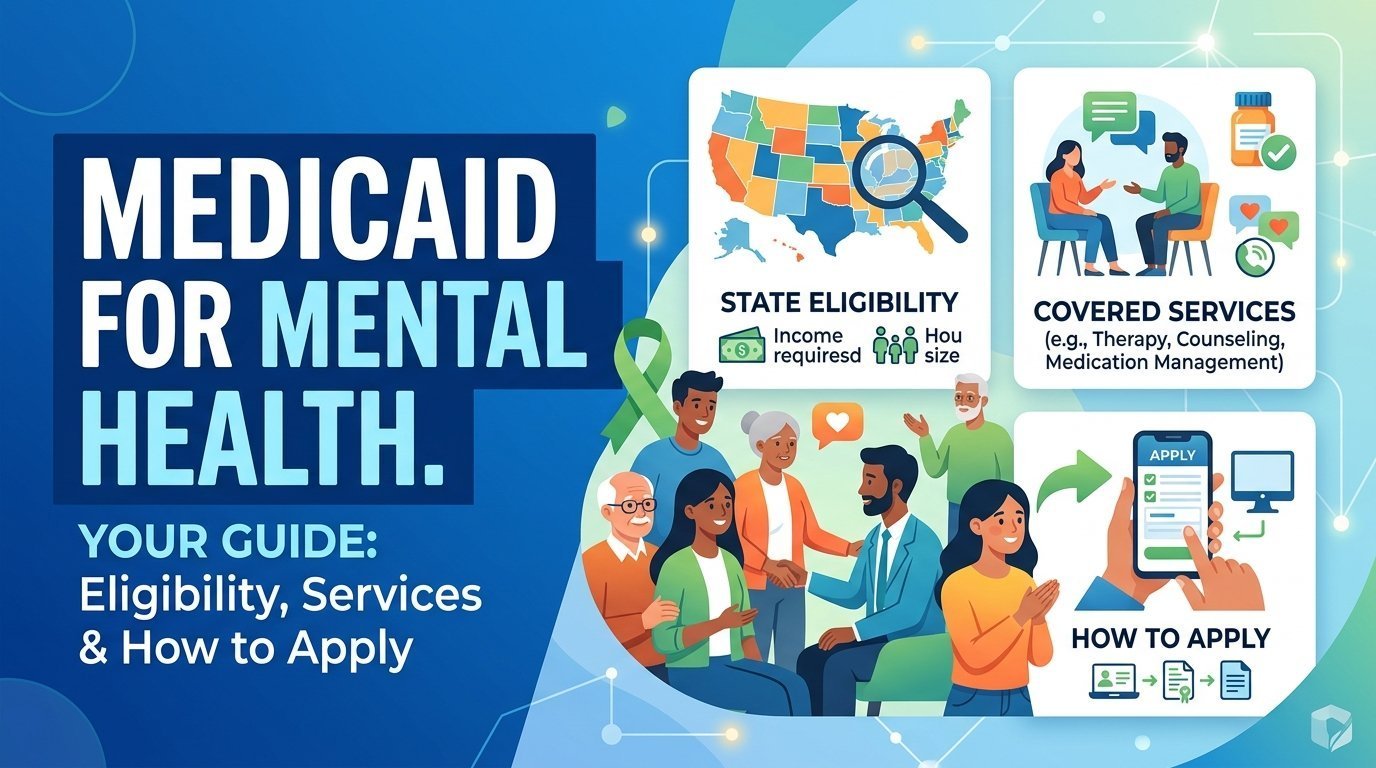
Medicaid is jointly funded by the federal government and each state, and each state administers its own version under federal rules. Eligibility is determined primarily by income, with a household income limit that the Affordable Care Act standardised at one hundred thirty-eight percent of the federal poverty level for adults in states that expanded Medicaid. As of 2026, that translates roughly to twenty-one thousand dollars for a single adult and forty-three thousand for a family of four.
Ten states have not expanded Medicaid. In those states, eligibility for adults without children is much narrower, and many low-income people fall into a coverage gap where they earn too much for Medicaid but too little to qualify for ACA marketplace subsidies. If you live in a non-expansion state and your income falls into that gap, ACA marketplace coverage with the lowest available premium may still be your best path to mental health care, since coverage at any level beats coverage at none.
Children are covered more generously than adults in every state through Medicaid and CHIP, the Children’s Health Insurance Program. Pregnant people, people with disabilities, and certain other categories receive expanded eligibility. People recently released from incarceration are increasingly being enrolled directly through reentry programs in many states, since access to behavioural health treatment dramatically reduces recidivism.
What Medicaid Covers for Mental Health
Federal law requires Medicaid to cover a baseline set of mental health services, but states can add to that baseline. The baseline includes outpatient therapy with a licensed provider, psychiatric medication management, prescription psychiatric medications, inpatient psychiatric hospitalisation, and emergency psychiatric services. Most states add coverage for intensive outpatient programs, partial hospitalisation programs, residential substance use treatment, peer support services, and community-based behavioural health services.
The strength of Medicaid in mental health care is breadth. Almost every level of care along the continuum is covered, including services that commercial plans frequently exclude or cover poorly, such as community mental health center visits, assertive community treatment teams for serious mental illness, and long-term peer support. The weakness is provider availability. Medicaid reimburses clinicians at lower rates than commercial insurance, which means many private-practice therapists do not accept Medicaid patients. The result is that finding an in-network provider can take longer.
How to Find Medicaid-Accepting Providers
The most reliable channel is your state’s community mental health center system. Every state operates a network of public mental health centers, typically organised by region or county, that accept Medicaid as their primary payment source. Search your county name and “community mental health” or visit your state’s behavioural health authority website for a list. These centers offer the full range of services, often including medication management, therapy, and crisis response, and they are designed for Medicaid patients.
Beyond CMHCs, federally qualified health centers, often called FQHCs or community health centers, also accept Medicaid and provide integrated mental health care alongside primary care. The integration is itself valuable. Patients who see their primary care physician and their therapist in the same building tend to stay more engaged with treatment than patients shuttling between separate offices.
For private-practice therapists who accept Medicaid, the best directories are the managed care organisations your state contracts with. Most states deliver Medicaid through MCOs like UnitedHealthcare Community Plan, Anthem HealthKeepers, Centene’s Ambetter, or state-specific plans. The MCO’s online provider directory will list participating mental health providers near me. Cross-check candidates by phone, since directories are often outdated.
Applying for Medicaid: The Step-by-Step
Apply through your state’s official health benefits website, or through HealthCare.gov for states that use the federal exchange for Medicaid applications. The application asks for income documentation for everyone in your household, including pay stubs, tax returns, or self-employment records. It also asks about household size, residency, and other coverage you may have.
Most applications are processed within thirty days, with retroactive coverage that goes back up to three months from the application date in many states. If you have outstanding therapy or psychiatry bills from the recent past, those bills can sometimes be reimbursed once Medicaid coverage is established. Save the bills, document the dates of service, and submit them after enrolment.
If your application is denied and you believe the denial is incorrect, you have the right to appeal. The appeals process is documented in the denial letter. Many community legal aid organisations help low-income applicants navigate Medicaid appeals at no cost. The persistence often pays off, particularly for applicants whose income or household composition is unusual or has changed recently.
Medicaid for Mental Health Across Major States
State-level differences are large. California’s Medi-Cal covers a wide range of behavioural health services and is implementing major expansions in mobile crisis, peer support, and street medicine programs. New York’s Medicaid program funds many of the country’s best-resourced community mental health centers. Texas Medicaid is restrictive for non-expansion adults but generous for children and pregnant people. Florida Medicaid has comparatively narrow eligibility but expansive substance-use treatment access in many counties. Pennsylvania, Ohio, and Michigan operate strong managed care systems with reliable mental health care networks.
Look up your specific state. Federal generalisations break down at the local level. Your state Medicaid agency website is the authoritative source for what is covered, who is eligible, and how to apply.
Combining Medicaid With Other Resources
Medicaid recipients can stack their coverage with other free or low-cost mental health care resources. Crisis services through 988 and mobile crisis teams remain available regardless of insurance status. Peer support specialists and recovery community organisations frequently provide free services. Some sliding-scale private-practice therapists will see Medicaid patients in addition to commercial patients, even when not formally in network, as part of their professional commitment to access.
Medicaid is not the perfect insurance product. The administrative friction is real, the provider networks can be thin, and patients sometimes wait weeks for an initial appointment. But for the population it serves, Medicaid remains the most comprehensive single source of mental health coverage in the country, often broader than commercial plans for higher-acuity needs. If you are eligible, applying is among the most consequential financial decisions you can make in your treatment.
This article is informational and does not constitute legal or medical advice. For state-specific eligibility and benefits, contact your state Medicaid agency directly. If you or someone you know is in crisis, call or text 988 in the United States.