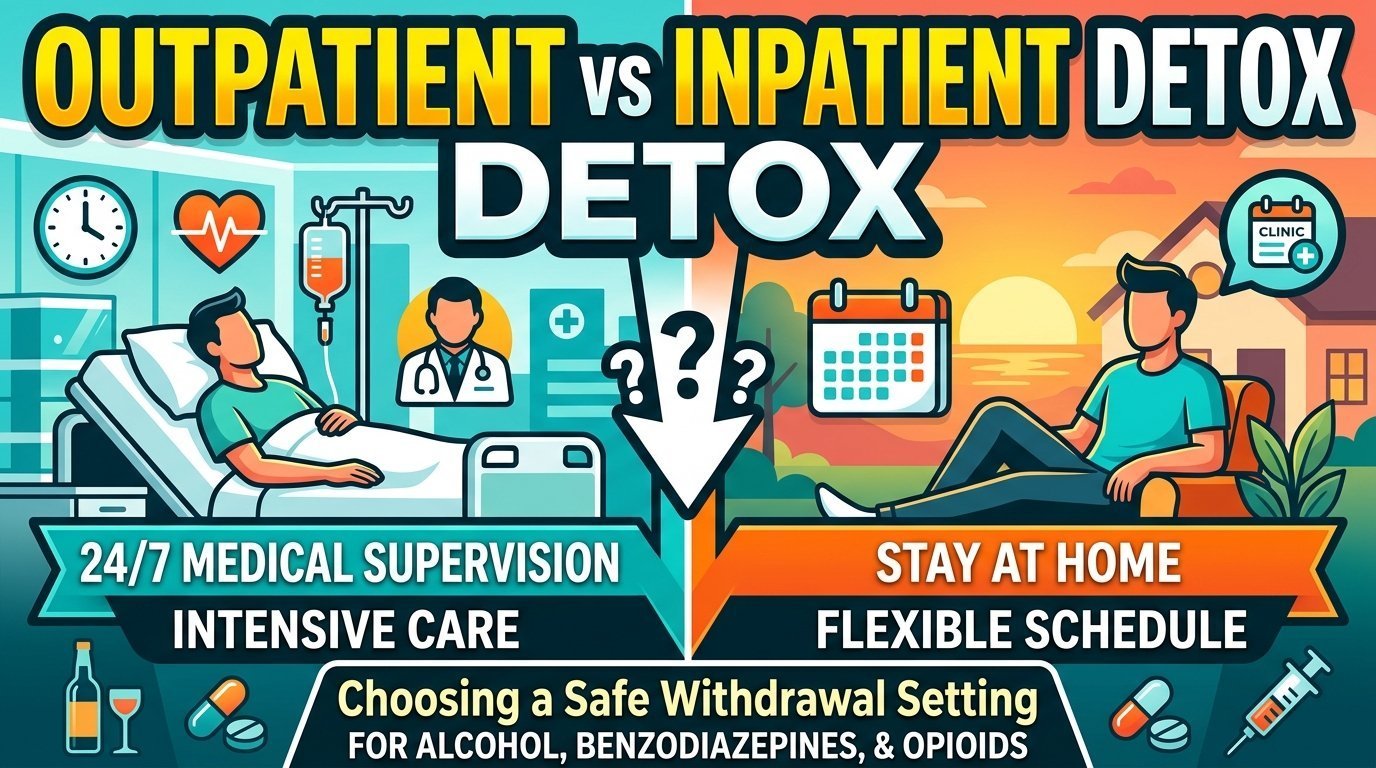
The first decision in addiction treatment is rarely about therapy or medication—it is about where to safely stop using. For some substances and some people, withdrawal is uncomfortable but not dangerous and can happen at home. For others, attempting unsupervised detox can be fatal. Choosing between outpatient detox and inpatient detox is one of the most consequential decisions in early recovery, and the answer depends on the substance, the patient’s history, and the available medical resources.
This guide explains how detox levels of care work in 2026, which substances require medical supervision, what insurance is required to cover, and how to choose a safe withdrawal setting without overspending or under-treating.
Substances Where Withdrawal Can Be Life-Threatening
Three classes of substances can produce dangerous, even fatal, withdrawal:
- Alcohol—heavy daily drinkers can develop seizures, delirium tremens, autonomic instability, and death. Severity correlates with daily volume, duration, prior withdrawal episodes, and co-occurring medical illness
- Benzodiazepines—long-term users of Xanax, Klonopin, Ativan, Valium, and similar medications can experience seizures, psychosis, and severe autonomic instability. Withdrawal can persist for weeks
- Barbiturates and certain other sedative-hypnotics—rare today but still encountered, with similar risk to benzodiazepines
For these substances, medically supervised withdrawal is not optional. The question is which level of medical supervision is appropriate.
Substances Where Withdrawal Is Uncomfortable but Generally Safe
- Opioids—heroin, fentanyl, prescription painkillers. Withdrawal is severe and miserable but rarely directly fatal in healthy adults. The bigger risk is post-detox relapse with reduced tolerance, leading to overdose. Medication-assisted treatment with buprenorphine or methadone is far safer than non-medication detox
- Stimulants—cocaine, methamphetamine, prescription stimulants. Withdrawal is psychiatric (depression, anhedonia, suicidality) more than physical
- Cannabis—mild withdrawal: irritability, sleep disruption, appetite change
- Nicotine—mild physical withdrawal, strongest cravings in the first week
- Hallucinogens—no significant physical withdrawal
ASAM Levels of Withdrawal Management
The American Society of Addiction Medicine defines five levels of withdrawal management:
- Level 1-WM—ambulatory withdrawal management without extended on-site monitoring. Brief office or telehealth visits with a prescriber. Suitable for mild withdrawal in stable, medically healthy patients
- Level 2-WM—ambulatory withdrawal management with extended on-site monitoring. Daytime check-ins at a clinic, returning home overnight. Useful for moderate alcohol withdrawal in patients with reliable support
- Level 3.2-WM—clinically managed residential withdrawal management at non-medical detox facilities, with 24-hour staffing but limited medical capacity
- Level 3.7-WM—medically monitored inpatient withdrawal management at hospitals or freestanding detox facilities with 24-hour nursing and physician availability
- Level 4-WM—medically managed intensive inpatient withdrawal management in hospitals, for severe withdrawal complicated by medical or psychiatric illness
Outpatient Detox: When It Is Appropriate
Outpatient or ambulatory detox can work safely when:
- Withdrawal severity is mild to moderate
- The patient has no history of seizures or delirium tremens
- Vital signs and lab work are stable
- A reliable support person can stay with the patient and bring them to clinic visits
- The patient has stable housing and can isolate from triggering environments
- Co-occurring medical or psychiatric conditions are well managed
For alcohol withdrawal, outpatient programs typically use a tapering benzodiazepine schedule (often chlordiazepoxide or diazepam), thiamine, multivitamins, and daily check-ins. For opioid withdrawal, outpatient buprenorphine induction is now the standard of care, often started in an emergency department or addiction medicine office.
When Inpatient Detox Is Required
Inpatient detox at a hospital or specialized facility is the safer choice when:
- The patient has a history of severe alcohol withdrawal, withdrawal seizures, or delirium tremens
- The patient is dependent on benzodiazepines and needs a slow medical taper
- The withdrawal is complicated by co-occurring medical illness (heart disease, liver disease, pregnancy, recent surgery)
- Severe psychiatric symptoms, suicidal ideation, or psychosis are present
- The patient lacks stable housing or supervision
- Multiple substances are involved—alcohol plus benzodiazepines, alcohol plus opioids, etc.
- Outpatient detox has previously failed
Inpatient stays typically run 3 to 7 days, occasionally longer for benzodiazepine tapers or complex medical cases.
Cost and Insurance Coverage
Out-of-pocket costs for medical detox vary substantially:
- Outpatient detox—$300 to $1,000 total, often less if your prescriber bills standard E&M codes
- Non-medical residential detox (Level 3.2)—$500 to $1,000 per day, 3 to 7 days
- Medically monitored inpatient detox (Level 3.7)—$1,000 to $2,500 per day
- Hospital-based detox (Level 4)—$2,500 to $5,000 per day, the highest level of care
Federal mental health parity rules require coverage of medically necessary detox by ACA-compliant plans, Medicaid, Medicare, and most employer plans. Pre-authorization is common but cannot be more burdensome than for comparable medical care.
Beyond Detox: The Continuum of Care
Detox alone has very high relapse rates—often 90 percent or higher—because withdrawal is only the first physical step. Effective recovery typically continues with:
- Residential rehab (often 30 to 90 days) for those needing structured environments
- Partial Hospitalization (PHP) and Intensive Outpatient (IOP) programs
- Medication for opioid use disorder (buprenorphine, methadone, naltrexone)
- Medication for alcohol use disorder (naltrexone, acamprosate, disulfiram)
- Outpatient counseling and group therapy
- Mutual aid groups (AA, NA, SMART Recovery, Refuge Recovery, Recovery Dharma)
- Sober living or recovery residences for transitional housing
Free and Low-Cost Detox Resources
- SAMHSA National Helpline—1-800-662-HELP, free 24/7 referrals to local detox
- FindTreatment.gov—federal database with filters for insurance, language, and special populations
- State Substance Abuse block-grant funded programs—available in every state, often with priority access for pregnant women, IV drug users, and veterans
- VA detox—free for enrolled veterans
- Hospital emergency departments—in most regions, can stabilize acute withdrawal and help arrange step-down care
A Final Note
The right detox setting is the one that matches the medical risk to the available supervision—not the most luxurious or the cheapest. For alcohol or benzodiazepines after long heavy use, err strongly toward inpatient. For most opioid withdrawal, outpatient buprenorphine induction is now both safer and more effective than older detox-then-rehab approaches. And for any substance, detox is only the beginning—what comes after determines whether the work of stopping was worth it.
This article is for informational purposes only and is not medical advice. Detox decisions should be made with a qualified medical provider familiar with your full history.