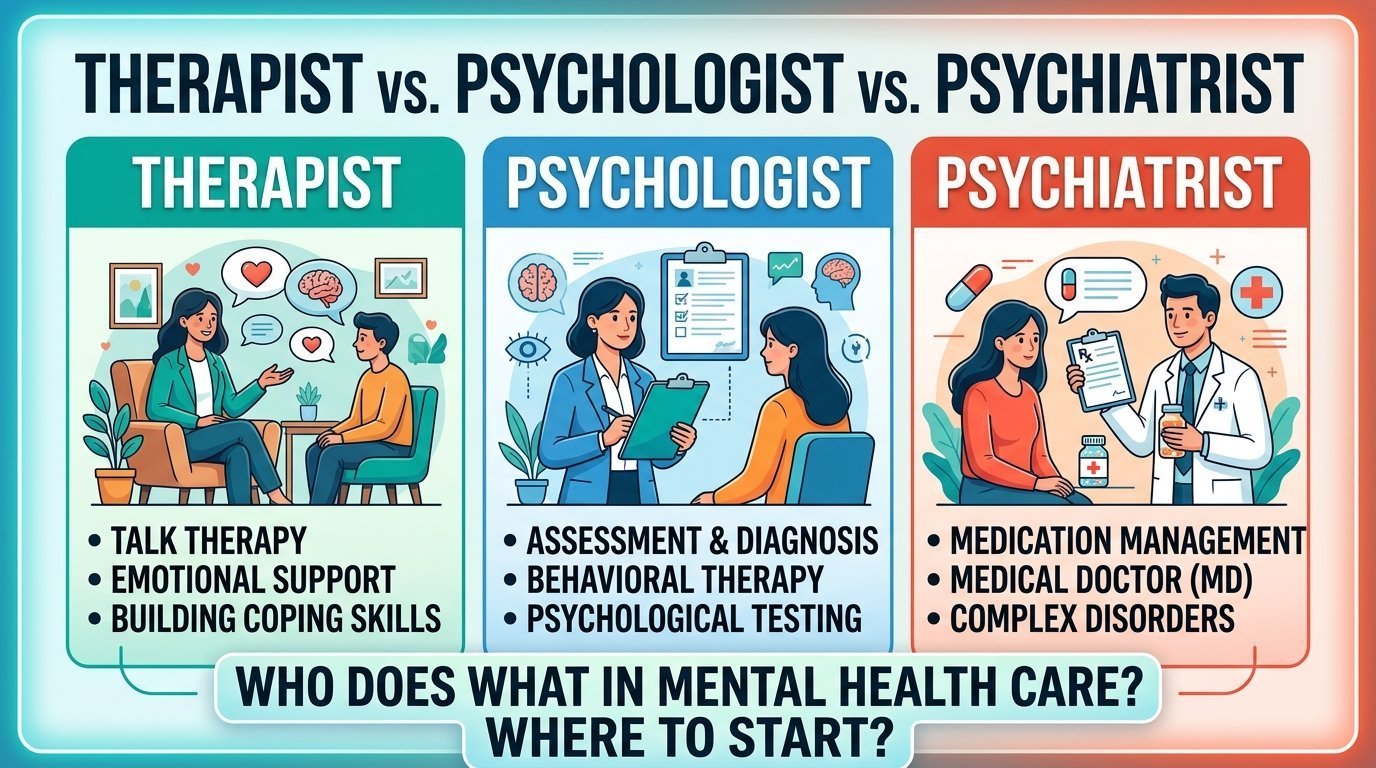
Three Different Professionals, Three Different Roles
Most patients searching for mental health care encounter three different kinds of providers and use the names interchangeably. Therapist. Psychologist. Psychiatrist. The terms are not synonymous. They describe different training, different scopes of practice, and different roles within a treatment plan. Choosing the right kind of provider for your specific need can be the difference between a productive course of treatment and months of mismatched care.
This guide describes what each professional does, what they cannot do, when each is the right starting point, and how patients commonly use them in combination. The terminology overlaps in confusing ways, and clarifying the distinctions up front saves significant time later.
What a Therapist Is
The word therapist is a general term that covers several different licensed professionals who provide talk therapy. Licensed clinical social workers, licensed marriage and family therapists, licensed mental health counsellors, and licensed professional counsellors all practice as therapists in most states. Each licensure category has its own training requirements, typically a master’s degree plus supervised clinical hours, followed by a state licensing exam.
What therapists do is provide psychotherapy. They meet with patients, usually weekly, for fifty-minute sessions, and use specific therapeutic approaches like cognitive behavioural therapy, dialectical behaviour therapy, EMDR, psychodynamic therapy, internal family systems, or others to help patients work through psychological issues. Therapists do not prescribe medication. They do not provide diagnoses for purposes of medical treatment in the same way physicians do, although they can identify and document mental health diagnoses for billing.
Therapists are usually the right starting point for patients dealing with depression, anxiety, relationship issues, grief, life transitions, trauma, and most general mental health care needs. They are the most numerous category of providers and the most accessible, with networks behind UnitedHealthcare therapists, Aetna therapists, Cigna therapists, and Blue Cross Blue Shield variants all containing thousands of in-network options in most regions.
What a Psychologist Is
A psychologist is a doctoral-level mental health professional with a PhD or PsyD degree, several years of post-graduate clinical training, and a state licensing exam. Psychologists provide psychotherapy in the same way therapists do, but with deeper training in assessment, research, and clinical theory. They also conduct psychological testing, including IQ assessments, personality assessments, neuropsychological evaluations, and diagnostic batteries that other clinicians cannot administer.
Psychologists do not prescribe medication in most states, although a small and growing number of states have authorised prescribing psychologists with specific additional training. The general rule is that psychological care from a psychologist looks similar to care from a master’s-level therapist, with somewhat deeper assessment capability and somewhat higher hourly rates.
Psychologists are particularly valuable when assessment is needed for diagnostic clarity, ADHD or learning disability evaluation, neuropsychological evaluation after a brain injury or for cognitive concerns, or for forensic or evaluative purposes. For routine therapy, the choice between a psychologist and a master’s-level therapist often comes down to fit, availability, and cost rather than training.
What a Psychiatrist Is
A psychiatrist is a medical doctor, with an MD or DO degree, who has completed psychiatric residency training. Psychiatrists are the only mental health professionals who are physicians, and the medical training shapes what they do. They diagnose mental health conditions through a medical lens, prescribe psychiatric medications, manage medication regimens over time, and coordinate care for patients with complex medical-psychiatric presentations.
Most psychiatrists today focus primarily on medication management rather than psychotherapy. Patients typically see a psychiatrist for an initial evaluation lasting sixty to ninety minutes, followed by shorter follow-up appointments lasting twenty to thirty minutes, with frequencies ranging from monthly to quarterly depending on stability. The therapy work is usually done by a separate therapist, with the two providers coordinating care.
Psychiatrists are the right provider when medication is needed, when diagnostic complexity benefits from a medical perspective, when the patient has medical conditions that affect mental health care decisions, or when the condition is severe enough to warrant the most credentialed level of care. Psychiatric nurse practitioners, who have advanced nursing degrees with a psychiatric specialty, can perform many of the same functions as psychiatrists, including prescribing, and have substantially expanded access in many regions where psychiatrist availability is thin.
When You Need Both
Many patients benefit from working with both a therapist and a psychiatrist. The combination is sometimes called split treatment. The therapist provides the regular psychotherapy, the psychiatrist manages medications, and the two providers communicate to coordinate care. This model works well for conditions like moderate-to-severe depression, severe anxiety, bipolar disorder, ADHD, OCD, and PTSD, where both medication and psychotherapy contribute meaningfully to outcome.
Some integrated practices employ both within a single organisation, simplifying coordination. Networks like UnitedHealthcare therapists, Optum behavioural health, and several Blue Cross Blue Shield variants increasingly contract with integrated practices that offer this model. For patients building a treatment team across separate providers, asking each provider to send a brief letter to the other once or twice a year keeps the coordination meaningful.
Choosing Where to Start
For most patients with general mental health care needs, the right starting point is a therapist. Therapy alone is sufficient for many conditions, particularly milder presentations, life transitions, and relational concerns. If after several months of therapy the symptoms have not improved sufficiently, adding a psychiatrist for medication evaluation is a reasonable next step.
For patients with conditions that have a strong biological component, including bipolar disorder, severe depression, schizophrenia, severe ADHD, severe OCD, or severe PTSD, starting with a psychiatrist or seeing a psychiatrist concurrently with therapy is often the right call. The medical evaluation produces diagnostic clarity and opens the medication option, both of which support the therapy work.
For patients seeking specific assessment, including ADHD evaluation, learning disability assessment, or neuropsychological testing, a psychologist is usually the right starting point. The assessment can clarify the picture before therapeutic interventions are chosen.
Cost and Access Comparisons
Cost generally rises with credential level. Master’s-level therapists are typically the most affordable, with session fees ranging from one hundred to two hundred dollars in private practice. Psychologists charge somewhat more, with sessions often two hundred to three hundred dollars. Psychiatrists charge the most, often two hundred fifty to four hundred dollars per session, with initial evaluations sometimes higher.
Insurance coverage varies. Most plans cover all three categories under behavioural health benefits, with copays in similar ranges after deductible. Out-of-pocket costs for out-of-network providers can be substantially higher for psychiatrists than for therapists. Access also varies. Therapist networks are typically broad. Psychologist networks are smaller. Psychiatrist networks are often the thinnest, with multi-month wait times for new appointments in many regions, although telehealth and the rise of psychiatric nurse practitioners have substantially improved access in recent years.
A Practical Search Approach
For a typical patient starting mental health care for the first time, the practical search approach is to find a therapist first, work with them for a few months, and then add other providers as needed. The therapist can refer to a psychiatrist if medication seems indicated, to a psychologist for assessment if diagnostic questions arise, and to other specialists as appropriate.
The framing simplifies the search significantly. Rather than trying to find the perfect combination of providers up front, you find one good therapist and let the treatment plan evolve from there. Most patients who follow this path end up with the right combination over six to twelve months, and the search is much less overwhelming than trying to assemble it all from scratch.
This article is for educational purposes and does not constitute personalised guidance. If you or someone you know is in crisis, call or text 988 in the United States.